Pages

Friday, January 17, 2020

A standpoint of status


Over the last three months, I've noticed a sharp decline in my ability to perform certain tasks.  Specifically, during the warm-up sessions at Parkinson's Boxing workouts.  Almost any coordinated movements between my hands and feet no longer happen.  If I get my feet going my hands stop and vice-versa.  Even marching in place has become nearly impossible to do.  So as I prepared a list of questions for my next neurologist appointment, I began to realize just how much functionality I had lost. I made a list of things I could no longer do and began wondering what would be the next thing to go.  I mentioned this to my wife and her comment, in return, struck a chord.  "Look at the positives", she said, "don't focus so much on the negative."  "Easy to say, hard to do", I thought.  Then it hit me, I've always been the optimist. Overly so, if you've ever worked with me on any project.  So what was different now?  I spent my career motivating others to get the desired results, now it was time to turn the tables and do something to motivate myself.  Movies, for me, have always been a good source of inspiration and motivation.  I remembered two moments that resonated, both from Apollo 13 and both from Flight Director Gene Kranz.  He was an amazing leader and can be attributed to some very motivating quotes. Who can ever forget "Failure is not an option".  That said, I'm not sure if the  lines I picked are actual quotes of Mr. Kranz or the writers of Apollo 13.  Either way though they certainly worked for me.  
Image result for apollo 13 movie kranz     
Gene Kranz (Flight Director):
"Can we review our status here, Sy, let's look at these things from a... from a standpoint of status. What have we got on that spacecraft that's good?"
Sy Liebergot (EECOM):
 "I'll get back to you, Gene."

The second quote occurs a little later as Gene overhears two NASA directors discussing the low survival chances for the crippled spacecraft:
“I know what the problems are Henry, this could be the worst disaster NASA has ever experienced.”
Gene Kranz:
“With all due respect Sir, I believe this is going to be our finest hour.

Both quotes demonstrate an ability to focus on the positives. Even when everything and everyone around you has nothing but bad news it's important to remember to find those positives.

For me, a new perspective; things could be a lot worse.  Each day is a blessing and should be lived like it.


Thursday, June 13, 2019

Battery replacement time for DBS system


Orange Safety Patrol Belt - Small

The initial installation of my DBS unit came with a non-rechargeable battery pack that was supposed to last 3-5 years. Unfortunately, the severity of my symptoms requires a higher complexity of programming and higher voltages both of which use more power resulting in the shorter life.  My battery signaled the need for replacement almost exactly at the two-year mark.  It was now decision time. Go with the same battery pack knowing that my symptoms will continue to get worse thereby draining the battery even faster. Or, go with a rechargeable battery but requiring me to make time to recharge the unit every day. My worry was whether I'd be disciplined enough to charge it every day. I think the answer to which one to get was clear.  With how quickly the initial battery drained and with the possibility of going through it even faster the next time, I decided on the rechargeable.  Additionally, there would be fewer battery replacement operations in my future since the rechargeable should last at least 10 years. Now I just had to persuade the surgeon. 
Fortunately, for me, it didn't take too much convincing.  When my neurosurgeon looked at the short life span of the original battery as well as my current and future electrical demands, he agreed that the rechargeable would be the correct choice.  He did jokingly say that if I go with the rechargeable unit, I wouldn't get to see him as much and that he would miss me. I blurted out "Don't worry, I would come visit you."  He smiled but a loud chuckle came from the nurse in the room.  She knew sarcasm when she heard it.

It's been over six months since I had the rechargeable installed and all-in-all its been a great choice. The daily recharge hasn't been an issue. I am up between 4-5 am everyday (thank you Mr. Parkinson's) and my mornings have become pretty standard: Let the cat out, make coffee, let the cat in, then sit and read for about 30-45 minutes.  It's during this time that I do the recharging.  With my current demand, 30 minutes is all I really need to maintain between 75% and 100% charged.  I've even missed a day and only dropped to 50% charge status.

The system I have is very nicely designed. Thank you to Medtronic for your engineering skills.  It's easy to use and does it's job quickly.  I simply place the recharging pad onto my skin directly over my battery and press go. The system checks the alignment and tells me how close I placed the pad to the optimum spot.  The closer you get to that sweet spot the better connection it has to the battery allowing more power to be transferred in the same amount of time. If anyone from Medtronic is reading this, it would be nice if the system told you which way to move the pad to get better alignment. The system comes with a strap so you can walk around while charging if you want.  I thought it made me look more like a crossing guard so if I do have to get up (probably to let the cat out again) I just hold the charger in place with one hand.  Oh, the recharging unit itself is portable since it is also a rechargeable battery that only needs to be recharged about once a month.  One other note that I didn't realize would be such a big benefit but actually is the best reason to get the rechargeable version.  The unit that is inserted into your body is thinner than the non-rechargeable one.  So the complaint I mentioned in a previous blog about always feeling it there when I moved around is almost completely gone.  I can lie on my side now with no tugging or it getting in the way.  Definite Bonus!

Thursday, January 3, 2019

What we've got here is a failure to communicate

I've never been a huge talker, or a medium one for that matter.  As self proclaimed King of the Introverts, I like to sit back and listen while adding just enough to keep a conversation going.  But, there's a big difference between not wanting to communicate and not being able to.  So much of our day-to-day lives depends on our ability to speak clearly and be understood. Some daily encounters may include:
Having to call the Doctor's office and schedule an appointment. Calling the pharmacy.  Run a meeting. Calling customer service because the store lost your shipment, talking to your bank or the insurance company.  The sales clerk at the store needs your phone number, or placing your order with the person behind the meat counter. These are just examples of when you know you are going to have to speak and can prepare for that moment. Unexpectedly running into someone you know, or getting a phone call that you must take are now frightening scenarios to me.    
In every instance of conversation you need to be understood. Unfortunately, Parkinson's may have other plans. For me at least, its become a huge problem, so much so, that I avoid contact where I can.  I may come across as aloof, or maybe just rude but its easier to avoid conversations when you know you wont be understood. 
So what to do?
For starters, I contacted my neurologist to make sure my DBS unit isn't the cause.  I had a thorough exam where my speech (and swallowing) were tested and retested with the unit on and off as well as my status in the medication cycle of either "on" or "off".  In my case, the DBS unit was not causing any speech or swallowing issues.
I then went back to speech therapy.  This time I tried the Speak Out Program developed by the Parkinson's Voice Project which is now available in many areas around the country.  They taught me some skills to  combat the slur that has overtaken my normal voice. They concentrate on getting your voice louder which is typical for most patients with Parkinson's.   However, my problem is more complicated and a quiet voice isn't where I am struggling right now.  It is the formation, stuttering and speed that I can't always control.  Their recommendations include slowing your speech down by thinking about each word and forming it correctly.  It does work, however I have trouble doing that AND having a conversation at the same time.  Throw on top of that another Parkinson's symptom like word finding and you'll see what I'm up against. Word finding, the occasion where you cannot think of the word even though you know the word and can describe it, is very frustrating. Take the word drain for example.  I've used that word many times and can describe its function however at that moment in the conversation where I needed to say the word.... Nothing.  I couldn't  come up with it. 
Forcing yourself to slow down and form each word makes it very difficult, for me, to have a quick conversation. The best way I can describe it is by relating to something I said years ago regarding swinging my arms when I walk.  I can do it when I think about it, but, as soon as I stop thinking about it, I stop swinging my arms.  For people that don't have Parkinson's the exact opposite is true.  Try walking and not swinging your arms and you'll see what I mean. When I think about what I want to say I forget to slow down and enunciate.
So, what do people do to try and help?  They hear your struggles and almost always try and finish your sentence for you.  Unfortunately, their idea of what I am trying to say usually isn't what I was thinking.  I've been misunderstood, and even said somethings other than what I meant just because it was they only sentence I could utter clearly at the time. I say things that I think are understood only to find out later that it either wasn't heard at all or the person got tired of asking me to repeat something and just nodded their head.  Oh, and for another level of frustration, try talking to one of those digital assistants like Alexa, Siri or Google.

I think that it would be safer if I handed out a card prior to any conversation:
Warning! - Person with Parkinson's
For those that have to interact with me, please be patient and assume nothing because you may or may not have heard me correctly.

There are 50 muscles involved in swallowing but over 100 could be used in proper speech.  With Parkinson's fighting muscle movements it seems impossible to hope that I will ever be clearly understood again.   Maybe its time to rewatch Cool Hand Luke.


Tuesday, April 17, 2018

DBS - is there a negative?

In my last post I discussed how DBS surgery has helped me continue working and allowed  the use of my left hand again.  Nothing I am going to tell you here should leave you believing that I have any regrets of having the surgery.  On the contrary, it can be life changing but its not free, figuratively or otherwise.

Image result for free to use negative clipart
The negatives:
1) The procedure - It is not painful however it is long. Once you are 'framed' into that chair you aren't moving for 5-6 hours.  There are plenty of people around you to help you get comfortable.  My back started to bother me and my legs got real jumpy by the end.  I think my body had enough.  Not a big fan of catheters either.  There was no pain when they implant the temporary posts to hold the frame to your head or when they were removed.  The hospital staff does a tremendous job of trying to keep you comfortable.  It's just that it is a long procedure and it does drain you. 

2) The battery implant - The battery pack is just plain annoying, even after nearly 2 years with it. Most of the time you don't really realize you have it but when you reach across your body for something, a little tug reminds you it's there. When you lay on your side it gets squished and uncomfortable.  It doesn't hurt you just know its there.  Bothersome is probably a better word. Also, it does wear out.  I haven't had to replace mine yet, I'm guessing by year three, but it does require another day-surgery when it comes time. I'm opting for the rechargeable one next.  I hope to get 10 years out of that one. 

3) The adjustments - It takes months to tune in the device as everyone's symptoms are different and there are hundreds of combinations of settings to go through to give you the best benefit. Even then, my symptoms aren't the same everyday or even the same throughout the day so, it's a bit of what's best in general.  My biggest problem with the adjustments is every time I have one scheduled, that day for some reason, I am at my absolute best. FRUSTRATING!  My neuro still manages to dial it in enough plus gives me enough adjustments in the remote to compensate for fluctuations.  

4) The cost - You need decent insurance for this surgery.  Typically its between $50-60k for the surgery then the follow-up visits are every 3 months for a while until it goes to twice per year.  Travel, time-off for surgery and appointments, plus the cost of the appointments themselves can get expensive.

5) The limitations - Its not a miracle cure for all that ails you.  In my case it works extremely well for the tremors and the slowness of movement I was having in my left hand.  Unfortunately, as you read in my previous blogs, there are over 80 symptoms that Parkinson's can cause.  Your Doctor will determine the best placement, probe and settings to control the worst of your symptoms but you will still have symptoms. Additionally, it doesn't slow the progression of the disease.  Its not meant to be thought of as a cure, more of a crutch.  What it can do it does very well but there are limitations.

6) The future - If you need it, you need it.  You can wait for the next best thing to come out (and it does and just did).  However, what they have out now works very well for the symptoms it can control.  Plus, its a proven surgery with thousands of success stories.  Don't let anything get in your way of being the best you can for as long as you can.

No one knows your future or how quickly you are going to progress.  In my case, I went from diagnosis to having the surgery in 5 years. I'm guessing that's because my Neuro called my disease "aggressive".  Yours will most definitely be different.  Listen to your Doctors, if you don't trust them find someone you do.  Even with the negatives I've listed, this surgery can give you back a part of your life you may have already thought you've given up. 

Friday, March 16, 2018

DBS after 2 years

It's hard to believe that it is coming up on two years since my implantation surgery.  Sounds weird saying it like that, "implantation surgery" and for you Star Trek fans, sounds very Borg-like.

So how has it been?  Initially, I would say very good.  I believe it is the sole reason I have been able to continue working at my job.  The initial tweaks removed the dystonia and painful cramping in my hand and eliminated my tremors.  DBS does those things very well.  However, as my symptoms fluctuate and constantly progress the system is having a harder time compensating or keeping up, as it were.  Each probe has so many adjustments that the tweaking could be endless, but, that's a good thing.  More, finer adjustments means longer adjustment appointments, however it gives the neurologist the ability to find the 'sweet-spot" with less side effects. My problem with the programming adjustments is that for some reason, I am always at my best when I see the Neurologist.  She makes these adjustments and asks how I feel.  "Great" always seems to be the answer but then I came in feeling great too. Just once I like to be seen at my worst - "There, adjust me now!"
One of the drawbacks to the surgery is the area they need to simulate is very near other important areas in the brain.  Not much room in there.  If my settings get adjusted too high, I get what can best be described as "leakage" into a nearby area.  In my case leakage into the area controlling facial muscles. This causes a noticeable slur of my words which when I'm "on" is fine and hardly noticeable.  But, when I'm sliding down to "off- state"  I am very difficult to understand and frankly get so frustrated I just make it worse. My Parkinson's symptoms tend to fluctuate day-to-day as well as throughout the day.  So expecting a device that sends out a distinct and constant pulse to keep up with all the changes is not something I would expect it to be able to do.  But, that said, when my meds are working, the DBS unit does a remarkable job.

So the big question remains "was it worth it?"  Absolutely.  The main reason I had the surgery was an almost useless left hand.  The tremor control was a bonus.  In some ways, now that my symptoms have progressed to both sides of my body, my left hand is more useful than my right.  I will have to work on that with at my next adjustment appointment.  
Next up:  Some of the negatives of the Surgery

Tuesday, August 30, 2016

DBS - The Main event Part 2

Two weeks after the initial probe placement I was scheduled for the generator, a.k.a. stimulator, a.k.a. battery pack installation.  This surgery is out-patient and the whole operation is supposed to last less than an hour.  It sounds quick and easy but you still end up spending most of the day at the hospital.
Arrival: 10:45 am, admin check in - same as previous surgery although I'm on meds and got a better nights sleep.  After a few minutes I am brought back to pre-surgical for gowning and IV installation.  
Pre-Op:  Still just as crazy as last time.  "Hmm, I wonder what that guy is in here for?" Could be anything as I listen to conversations all around me.  Same process as last surgery, nurse visit, then Anesthesiologist, Surgeon, intern, Anesthesiologist's intern then up to surgery.  This time, however, they inject you with, well..., lets just call it happy juice.  
Surgery:  At some point on my way to the operating room, I was out because I have no recollection of even getting there.  I especially do not remember stating to a group of nurses in the hall, "hey look, there's a gaggle of nurses".  A statement only my youngest daughter would find funny as I have been calling groups of anything 'gaggles'. Did you know that a group of:
Bats are a Cloud - as in, "Look at that cloud of Bats!" 
Butterflies are a flutter
Crabs are a cast
Crows are a murder
etc..
I think it's insane that there are all these different names so I call a group of anything a gaggle.  See, I told you only my youngest would find it funny.
Post-Op:  I wake up and my throats sore - ventilator tube used during surgery, ugh.  I have a newly shaved spot on the side of my head where they connected the leads from my probes to the leads from the battery pack.  Oh, and of course I have this bulge over my left collarbone. Its now 3pm, "where did the day go!"  
The battery pack.  I'm told that after a month your mind gets used to having something foreign installed.  I hope so because it is only the first week and the pack is already bugging me. It doesn't hurt but when you move certain ways you know it's there. If I'm going to carry this battery around with me, the very least they could have done is given me a USB port so I could charge my phone. 
I've been wearing a hat to hide the incisions on top of my head as the hair grows back. I'm not embarrassed, its just I don't want to gross people out when they look at me.  Plus, I'd rather not get into a big discussion about what is going on every time I bump into somebody I know.  The problem is the new incision on the side of my head is right where the hat lays.  What a pain, literally and figuratively.  
Unlike the first operation, there was no boost from the insertion of the battery pack.  I heal for a couple weeks then I get my first of many programmings.   After nearly two weeks there are still some tender spots, especially where the leads run under my scalp.  Bruising and swelling around the pack is almost gone.  Stitches on the side of my head are ready to come out.  So lets fire this baby up and see what she can do.

Next:  In deference to the late great Gene Wilder, "Alive, It's live, It's alive!"

Friday, August 26, 2016

DBS - The Main event

OK. all hoops jumped through, I's dotted and T's crossed.  I was good-to-go for surgery.  I had to arrive at the hospital by 5:30am after not taking any medications the night before.  As some of you will remember from my previous posts, I don't sleep well without meds.  As expected I was up all night, so it's off I go to have brain surgery on zero sleep.
This may sound trite after the fact but I was surprised by how NICE everyone was at the hospital.  From the person that checked me in, to all the nurses (I think at last count, I was introduced to about 40 by the time I left). I've been to three different hospitals in the past two years and without a doubt, the people at Strong URMC are the best at what they do.  No comparison.  So best as I can remember here is the blow by blow.
5:40am - checked in with hospital administrator - normal questions, insurance, etc.  Then they explained to my wife how I will be assigned  a number that she could use to track me on monitors in the waiting rooms as I went through various stages.
Pre-surgical - this is where you change into your gown and the first of the 175 vitals are taken from you that day.  Also where you get the attractive bracelet used to keep track of every med they give you going forward.
From here I was brought into an area that can best be described as a symphony in chaos. Pre/Post Op.  People, surgeons, anesthesiologists, interns, nurses, patients, family are moving all over this room.  The good news was my family could be with me up until this point.  Here you meet all the people that will have a hand in your surgery that day.  Finally, the neurosurgeon walks in, looks at me says "Are you ready?"  After a quick thumbs up, it's a tearful goodbye to my wife then up to the operating room.
Operating room.  I guess you could say it was exactly as you would picture it would be for brain surgery.  Equipment everywhere.  And the people!  I lost track but there were nearly 20 people floating in and out of that room.   First up, the part I was dreading the most:  The catheter. I don't know why I stressed over this one tiny piece of the operation more than any other, but I did.  Then I got some good news.  After a numbing agent was applied (yes that was weird) I would be temporarily put out so they could do the catheter and attach the headgear. I guess I was out about 10 minutes and now I was being whisked over to a CAT scan so they could do a final map and overlay it with the MRI.  
The prelims were now over.  I was back in the operating room and here is where the meat of the operation was going to take place.  They moved me onto a narrow but surprisingly comfortable molded chair and my head gear was fastened down.  As many monitors were attached to me as my available open skin space would allow.  A quick shave of the head area and it was time for some Lanicane on my scalp.
"Ouch," I shouted out as the surgeon cut into my head with the scalpel. "you felt that?" was his response  "Yes!" I said emphatically.  After more Lanacane was administered they finally got to work. It was a weird feeling, knowing they were doing something up there but not being able to feel it.  At one point I heard something that sounded like the Doctors were scraping on the metal bars surrounding my head.  I asked the nurse what they were doing and the Surgeon piped up that they were removing some tissue covering my skull.  It was almost surreal.  Here they were, scrapping directly on my skull.  I couldn't directly feel it, but the sensation I had was like it wasn't attached to me.  
Drill time.  They prepared me for the drilling explaining exactly what will happen.  Loud noise followed by a loud click as the clutch engaged and voila, you have a new hole in your head.  The first one took about eight seconds and was exactly as described.  The second one was much quicker but didn't sound right.  The drill must not have done as good a job this time as I could feel the surgeon doing some clean-up with some nippers. No pain mind you, I just could feel it.
Probes.  They inserted the probes and then it was the neurologists time to shine.  Her job was to make sure they got the probes in the correct place.  A lot of it was done with sound which is cool as they listen to your neurons fire as they move your limbs. The last bit was a little strange, though.  They purposely go too far to make sure the probes are where they think they are.  This puts them into the part of the brain that works with the eyes.  The neurologist tells me to look for sparkles or lights and tell her where they are in my field of view. Not sure what this does for them but they seemed pleased with my responses., They temporarily applied voltage to the probes and it was amazing!.  My arm completely relaxed which it hasn't done in five years.  I could make a fist again and there were no tremors.  Now, this is what I had been waiting to see.  I got to keep most of that freedom even after they turned it off because of something to do with the trauma of the surgery creating some sort of temporary improvement. It lasted about three full days and was wonderful!
Closure.  With probe placement now complete, it's time to button me up.  Picture a staple gun attaching a small titanium disc to your head.  That's what it sounded like.  Again, there was no pain just this weird sensation of them attaching something to my me. Shortly after that it as back to where I started in Pre/post op.  I was exhausted and dozed off for a couple hours.  I know my family was anxious to see me but there was nothing that could keep me awake at this point.  I woke up around 3pm and had the family come in along with four ice cream cups!  My reward for making it all the way through.
I found out later that after each step of the process a nurse would call my family and update them on how I was doing.  Again, I would like to compliment the staff at Strong URMC for their wonderful care.
You get one night in the hospital so they can monitor you.  Then after a quick check by the surgeons, you're out the next morning.
Recovery.  Apparently, exposing the brain to the air can cause some of it to be trapped inside your head when they close you up again.  This gives you the feeling of having a sinus infection.  Your head pounds a little when you bend over and you feel a little dizzy...  This took me about 5 days to get over.  After that, the most annoying thing was how much the stitches itched as the wounds healed.  My scalp was a little sore too, where they tucked the wires awaiting attachment to the stimulator in the next Operation.
Speaking of which, on to the next post
Battery Stimulator placement.

Thursday, August 4, 2016

DBS - Steps three and four

Steps three and four, to me, are the most interesting of the hurdles you need to clear before gaining admittance to club DBS.  Step three is a full psychological examination and step four is a meeting with the Neurosurgeon.

Step 3
Entering into the room with the Neuropsychologist (No, I didn't know one existed either) she asked, "do you know why you are here?"  I jokingly answered ' to make sure I have no plans to kill myself"  "Well, kind of" was her response.  "Kind of?" I thought "But, I was only joking..."  It sobered me up to how serious these evaluations were.  The group of specialists the University of Rochester had put together was there to make sure I was a good candidate. I initially thought it was purely to make sure their 'successful surgery' numbers better by weeding out candidates that would not show a strong improvement from the surgery.  I was surprised to find out it was much more.  They were genuinely concerned about how the surgery would affect me.  They wanted to make sure I had the best outcome possible.
By participating in Michael J Fox's PPMI study for the last five years I have been privy to many of the psychological tests I was about to be given.  While the tests were familiar I still thought I did worse than the last time I took them.  There were more than just memory tests, though.  Discussions on growing up, my siblings, parents, and relationships all were fair game.  We touched on a lot of subjects.  I must have answered most of the questions to her satisfaction because, in the end, she said she would recommend me for the surgery.  So, I was off to the next and final step.
Step 4
The meeting with the neurosurgeon was about two weeks later.  He was exactly as you would think a brain surgeon would be. Tall, witty, and just a little bit cocky.  He exuded confidence which, personally, I think you would want from a guy about to get an up-close look at your brain.  He patiently answered every question my wife and I had.  We asked about problems he has encountered with previous surgeries, what they do to reduce the possibility of infection and stroke, new emerging techniques and are they worthwhile waiting for, which unit he would be implanting, and an hour-by-hour breakdown of the surgery day.  He even commented that as a patient I was required to bring a joke to the operating room.   Over the next several days I thought about looking one up on Google.  I mean, there must be Neurosurgeon jokes out there somewhere, right?  Then one occurred to me.  "What is the difference between a Neurosurgeon and a Proctologist", I will ask the Doctor after getting wheeled into position. Hopefully, his answer will be "I don't know" at which time I will shout "hold it, stop the operation!"
He approved the surgery to move forward and now the dreaded wait begins for the scheduling person to call. It's obvious (and I guess good) that these people are in no hurry.  If they were in a rush there probably is something majorly wrong with you and they want to get in fast.  As excruciating as it is I will wait patiently to find out my drill date.

This whole process, from initial thoughts of having the surgery in March to the actual day of the surgery in August, has taken five months!  I'm not sure if that is typical but from what I gather reading others comments it's not far off.

Well, as I finish writing this, its T-4 days until the big event.....
"See you on the other side, Ray"

Thursday, July 28, 2016

DBS - Step Two in the approval process

After making it through the initial qualification for Deep Brain Stimulation (DBS - see my last post), I prepared for step two, evaluation without and with medication.  Sounds easy enough, no meds for 12 hours previous to the exam then get to the Doctor's office and get evaluated.  Unfortunately, I forgot a couple of things.

1) I haven't been completely off medications for a while so I forgot how difficult simple tasks can be
2) Since this is a progressive disease I really had no idea how bad I would be.

I did think ahead a little bit though and got a hotel near the Doctor's office so I wouldn't have to make the 2-hour trip while unmedicated.  As it turned out, that would be the least of my problems.
About an hour past my reminder to take my next dose of meds I started tightening up.  My left foot was dragging and my face felt like it weighed 10 pounds.  I could tell my speech was starting to struggle so I reviewed my exercises from my last therapy appointment to avoid any awkward moments checking in to the hotel.
I made it to my room and as I lay there watching the Yankees get beat up on TV (again) things started happening fast.  I was getting weird spasms in my arms and legs.  My restless leg was now in high gear and my movements had slowed to a crawl.  Then the aches started and I knew it was going to be a long night.  Just how long, I was unprepared for because no matter what I did, positions I tried, or place I attempted to lie (bed, chair, floor) I couldn't sleep.  It would be a long night.  Lucky for me there was some good TV to watch (thank you Fraiser and the movie Monuments Men).  This got me through to morning as my night went from lying down to sitting up to pacing and back to lying down as I tried desperately to get comfortable.  I thought to myself "Well, the Docs going to get me at my worst for sure.  I took a shower and headed out for some coffee hoping it would work its miracle and keep me awake through the testing.
If you've ever taken your car in for service you have probably experienced this.  The car is making a strange noise.  Ever time you do 'this' with the car it makes the same noise so you take it to a mechanic.  He gets in the car and like magic, there is no noise.  Well, after the coffee and moving around outside for about an hour that's how I felt going into this appointment unmedicated.  As bad as my symptoms were the night before they were much calmer by the time I got to the appointment.  The Parkinson's was still there but, not in the nearly institutionalized, spasmatic version they appeared to have me in the night before.  "That's common," Dr. Burack (my new neuro for DBS) told me. Apparently, the withdrawal from both Amantidine and Sinemet can cause the pain and spasms I encountered.  I didn't like the thought of being 'hooked' on a drug but at this point I have little choice.  Hopefully the DBS surgery can reduce my need for some of the 18 pills per day I am now taking.  
The exam was typical of every other neurological exam for Parkinson's except you get to do it twice.  Once off meds and again after your meds have kicked in.  Since it takes my body almost 45 minutes to an hour for the medications to work their magic it gave me the opportunity to  ask a lot of questions about latest techniques, probe placement, what the day of surgery is like, etc.  I will share these in an upcoming post.  
On to Step 3

Monday, May 16, 2016

Deep Brain stimulation - DBS from the patient perspective

It astounds me how the progression of an idea works. I mentioned this in an earlier post but I think it's worth noting again.  Somebody at some point looked at a calf getting milk from its mother and thought, "hmmm, I wonder if we could drink that."  The same applies to other things like coffee and chocolate - "Let's do these 19 steps to this bean and we might have something good in the end."  The discovery of something new and the progression of how it got to that point intrigues me.  Somewhere along the line, someone witnessed what happens when an electrical charge is given to the brain. They applied that information to invent a procedure that today has been performed over 250,000 times.  Amazing.
There are plenty of sites that describe what Deep Brain Stimulation (DBS) is and how to take one for a test-drive.  I thought I would do something a little different and tell you about it from the perspective of someone going through it.  Namely...me.

How the thought of DBS even got in the discussion.
I always thought DBS was in my future.  I figured by the 10-year mark of my diagnosis my symptoms would progress enough and the technology would advance enough for me to have the surgery.  Well, here I sit at the 5-year mark contemplating DBS pros and cons.  In my last PPMI visit with my neurologist, Dr. Richard, and her assistant Paul DeRitis at the Univerisity of Rochester, we discussed the dystonia (distortion) and bradykinesia (slowness) still hindering my left hand.  On medication, my hand will open and close albeit VERY slowly making it difficult if not impossible to use.  Fine motor skills like picking up screws or nails to work around the house cannot be done.  Off meds, my hand curls closed like a hook and is useless. Our discussion centered around my medication regime and if there was anything else that could be adjusted.  I'm maxed out on Carbidopa/Levodopa as any more and I start to get the rolling wave of dyskinesis starting with my head and working its way down to my torso.  Nothing on the scale of Michael J Fox but dyskinesis none the less. Other Parkinson's meds are a no-go due to the side effects associated with impulsivity.  So Botox was mentioned.  The premise here is there are two muscles involved in most movements.  One pulling and one relaxing - think bicep verses triceps.  The thought is to inject Botox into the muscle of my hand to relax it so it won't form my hand into a hook. A couple of problems with this procedure: One - it only lasts a few months and you have to get reinjected.  Two, it weakens the muscle.  I'm already struggling opening things like Ziploc and Potato chip bags.  If this makes it worse I'll really be in trouble. I wasn't getting a good feeling about this procedure so I asked what else we could do. This is where they suggested I consider DBS surgery.

DBS appointment - Step one
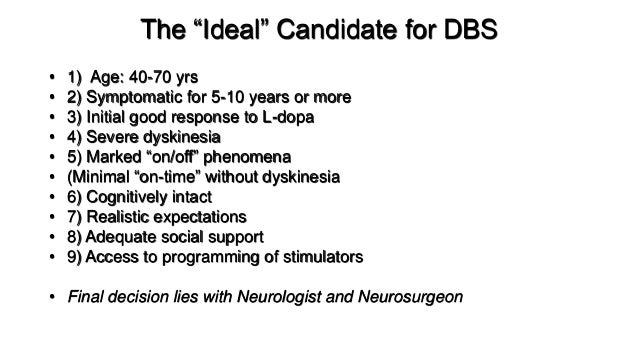
With the anticipation of going down the DBS route, I get to add another neurologist and now a neurosurgeon to my repertoire of medical professionals. Dr. Richard and Paul are phenomenal and if you're near upstate NY I highly recommend you seek them out.  However, now I get to deal with another highly regarded movement disorder specialist, Dr. Burack also of the University of Rochester.   The new neurologist works in tandem with the neurosurgeon to perform the DBS surgery. While the surgeon is doing the cutting and insertion of the electrodes, the neurologist is directing the precise location and final placement.  I'm getting ahead of myself though.  Step one is to meet with the new neurologist to see if you qualify for surgery.  Apparently, to qualify for DBS you have to meet certain criteria.  
The “Ideal” Candidate for DBS
• 1) Age: 40-70 yrs
• 2) Symptomatic for 5-10 years or more
• 3) Initial good response to L-...
This is a suggested list, not a hard and fast rule.  Some places have their own criteria or worksheets to determine if you qualify.  The University of Florida has a multi-part form that is graded to see your probability of being a good patient. (here)  I can understand why they require you to be physically ready for the surgery, but I was not expecting all the questions on the mental readiness part.  Number 7 (above) Realistic expectations?  Would the surgery not work as well if I expected it to do more for me?  Number 8 - adequate social support- why?  To keep me from getting depressed if it doesn't work as well as expected?  There may be some side effects of this operation that I need to dig into more. 
 So after a couple hours of questions and a brief exam the neurologist determined that I qualify to move on. Step one, check, but I'll have to go back and ask her how realistic my expectations were.

Next up - Step Two - an MRI and examination off medication. 

Monday, April 18, 2016

Speech therapy Round 2

A frequent conversation starter between me and anyone new:
"Hi, I'm Don, glad to meet you." 
The response, "Hello Dan, It's nice to meet you."

The first few times I used to think "what is wrong with these people, can't they get my name right?"  This has been going on for about a year now. With more and more people from all walks of life thinking my name is Dan, I've decided to either do something about it or buckle to the pressure and change my name.  
 My second visit to the speech therapist was just as interesting as the first (see the previous blog for that adventure.)  It would seem my facial muscles and tongue have been taking advantage of the lower amount of signals from my brain and have been getting lazy.  The exercises my therapist gave me will help whip them into shape. Some examples:
  • Open your mouth - come-on...  wider (I'm starting to sound like my therapist!)
  • Stick your tongue out - further - feel the stretch
  • Now try to touch the tip of  your nose with your tongue.
  • Purse your lips and say ooo....
  • Now make a very wide smile and say eeee...
  • The LSVT LOUD® training was interesting .  Holding an ahhhh sound with your mouth wide open for as long as you can up to 30 seconds.  Repeat - a lot.  Then start low and ramp up to a higher pitch again holding for up to 30 seconds. Repeat.  Now reverse it and start high pitched and end low. Repeat.
Do these for a while and you can really feel it in your throat.  Just like exercising, the muscles get tired.
One of my initial signs of Parkinson's was the ability to trigger a tremor by holding my hand out straight and twisting my wrist. It's part of cogwheel rigidity.  Well, I've run into another trigger from this last exercise that's supposed to give me back some control and flexibility in my face. Scrunch your lips up like you are going to blow a kiss.  Now shift that smooch as far left as you can.  Now as far right as you can.  Do that 10 times.  When I try, I trigger a facial tremor.  I can't always get my lips to go right without some twitching and tremoring. Frustrating.

Parkinson's will continue to degrade both swallowing and speaking as well as many other symptoms. Unfortunately, the goal of these exercises for is only to prevent me from getting any worse.   Nothing yet can reverse the degradation.  
So if we can't reverse it, what's the goal?  For me, it would be to reduce the amount of people asking me to repeat something.  Short of that, it just would be nice to be called Don again.

Thursday, April 7, 2016

Parkinson's, Swallowing and the Speech Pathologist

"It's stuck,"  I thought.  For a while now I've had some difficulty swallowing consistently.  At times, it felt like the food was stuck about halfway down.  Plus there was the occasional 'went down the wrong tube' coughing fits.  None of this really worried me until I did research on the previous blog - you did read it didn't you?  Go ahead, we'll wait......
I didn't like the thought of possibly aspirating anything into my lungs which could lead to pneumonia.  To try and stay one step ahead, I set up an appointment with a Speech Pathologist.    
The exam - was really cool!  I've always been enamored by how my body works so I was really looking forward to being able to stand in front of a screen and watch as food and liquids went down my throat.  It didn't disappoint.  We started with the obligatory barium swallow. (I believe there's a reason you don't find Barium flavored ice cream, yuck.)  This was followed by several types of liquids and solids:  water, an egg salad sandwich, pudding, cracker etc.  Afterward, I got to watch as they played back each item.  In many cases, you could see that not all of the food would go down my esophagus on the first or sometimes the second swallow.  There seemed to be a little pocket where food was hanging out until I swallowed hard to force it down.  The technician did her best to explain how swallowing worked along with all the different muscles involved.  She also explained that with Parkinson's there are delays or smaller movements that interfere with the process of swallowing.  Just as I feared, this disease is affecting me here now too.
The therapy - I was recommended to see a speech and swallowing therapist to try and combat what was starting to happen.  Food getting stuck was one thing.  Aspirating food into my lungs was not the road I wanted to be on.  No, I'd like to put off pneumonia for as long as possible if not avoid it all together, please.
The therapist started by watching how I spoke and then watched as I swallowed some items.  Her comments were interesting such that I have heard Parkinson's described many different ways but this was new.  She said, "Parkinson's wants to make everything..". "Slow" I piped up.  She said "yes, but regarding muscles, it really is trying to make every movement small." When I thought about it, especially with movements of the face, the muscles really don't want to move much, therefore, your voice gets lower and sounds more slurred. In this instance, it was primarily my tongue that was not holding up its end of the bargain.
She described the tongues role in swallowing.  It's kind of the driver that gets things started down the esophagus.  In Parkinson's the tongue either moves too slowly or not completely back (or both) to properly aid in forcing food down the tube. 
So what to do.  We focused the remainder of the visit targeting swallowing as that can be most detrimental to my long-term health.  We started with:
Buttercup.  Say it out loud.  Annunciate! was the demand from my therapist now cracking the whip. (Side note: if you have a choice get a therapist that will push you and not let you fall into old habits.  I know what they are asking is hard but if it was easy we wouldn't need them now would we?) So say it with me...  BUT-TER-Cup.  If you do it right you will feel your tongue move back and forth in your mouth.  
Say Earl.  Now say it like you mean it.... Eaaaarrrl, puckering those lips.  Say it correctly and you feel the tongue hit the back of the throat. "Now give me 10 of each of these 5 times a day" was the homework assigned.   One note of caution, correctly done in the presence of others will cause laughter from family members or strange looks if you're in public.  Don't get me started on if you do these in the presence of someone named Buttercup or Earl.
There were several other suggestions she had to help prevent choking, especially with thin liquids. One was to take a short breath and slam your larynx shut by making a hup sound then hold your breath.  Now take a drink and magically the liquid goes down the correct tube.  The problem with this?  Trying to remember to do it before taking a drink.  Her recommendations at this stage of my Parkinson's was to concentrate on doing it more when my symptoms are at their worst, like when I haven't slept or at the end of the day.  

Next up - Second therapy session - working on proper diction or Who's Dan?

Friday, March 25, 2016

You don't die from Parkinson's

I'm linked to a lot of sources that feed me articles on the internet having anything and everything to do with Parkinson's.  This allows me to follow much of the latest research as its happening.  Along with the scientific articles though come mainstream media reports on people with Parkinson's and the people taking care of them.  You get the occasional heart warming story, but many times what's reported is wrong or, at least, I hope it is.  
Everything I understand about this disease boils down to this one truth I've held on to:  

You don't die from Parkinson's you die with Parkinson's. 

So why does this have me riled up today?  I'm tired of reading articles from people assuming the worst.  Radaronline wrote an article on how bad off Michael J Fox looked recently.  Their article commented on his need for help getting into a car, slurred speech, speculation on the probability of his need for a wheelchair in the near future along with developing dementia.  Anyone that did five minutes worth of research would realize how inflammatory this reporting is. Two other articles reporting the same sighting of Mr. Fox comment on how good he looks and don't wildly speculate on his medical future.
To make matters worse, their article continues by comparing him to Robin Williams and his tragic suicide.  Are they suggesting Mr. Fox is on the same path?  Again, if they would have taken a minute they would have realized Mr. Williams actually had Lewy-body dementia which is a much harsher disease.  Mr. Williams was clearly depressed and distraught and the comparison to Mr. Fox was not only unjust but harmful for people that are not well informed about these diseases.  But headlines sell papers so I guess it doesn't matter if it's true or not.  It's easy to look up, Parkinson's is a boutique disease. Everyone is on their own path. What symptoms I get can be vastly different in type, severity and speed of decline from the next person. 
Maybe I'm naive or maybe just misinformed.  You see, I'm the eternal optimist.  I rarely see the bad side in situations and always figure there is some way I'll pull through. This may not be the best way to view life but it has managed me well these 51 years and I think keeps me happier than the alternative.  I wouldn't say I have my head in the sand, quite the contrary, I'm wide eyed and ready for that next big breakthrough.
It got me wondering, though, why do so many people say a person 'succumbed to Parkinson's' or more plainly 'died from Parkinson's'?  So I started digging.
The center for disease control lists Parkinson's Disease as the 14th leading cause of death. But how could this be if you don't die from Parkinson's?  The answer, unfortunately, is semantics.  Parkinsons's affects so many different areas of the body you knew one of them would have to sneak up on you.  Top two you ask? 
  • Pneumonia 
  • Hitting your head in a fall.
Pneumonia with Parkinson's people is caused by improper swallowing or dysphagia.  Food particles end up in the lungs which can lead to the development of aspiration pneumonia.  Parkinson's induced balance problems are the leading cause of falls.
To get ahead of the curve, I set up an appointment with a speech pathologist.  They will look for the tell-tale signs of problems swallowing with Parkinson's and with therapy, delay or even eliminate the possibility of dysphagia.  As far as falls go, short of wearing a helmet, I'm going to have to do more research.  I do know the first thing that jumps out is getting rid of throw rugs. Also, exercise and vitamin D to strengthen those bones.

Next up:  My visit to the Speech pathologist

Good information on PD-related falls here and here
Excellent study on both speech and swallowing problems in PD here


Sunday, January 10, 2016

The C word

Among the few benefits there was to having Parkinson's Disease had been the theory that along with the diagnosis comes a reduction in the likelihood of getting most cancers. Recently, however, various studies have been poking holes in that belief. While the debate still goes on as to whether Parkinson's helps or hurt certain cancer formations all conclude that Parkinson's Disease patients have a MUCH higher rate of skin cancer than the 'normal' population. From double to nearly four times more likely depending on who you listen to.  So after conversing with my neurologist, her recommendation was to get an examination by a dermatologist and repeat them yearly.

With that knowledge, I immediately called the dermatologist office to set up the appointment - Ugh, six-week wait.  If you've read some of my earlier posts you would know that I don't wait very well.  If there is something that needs to be checked I want to do it now.
The wait went quicker than expected with Christmas and New Years acting as a nice diversion and now it was appointment day.  The exam was pretty quick also. Under a magnifying glass, the dermatologist examined anything that looked other than what could be called normal skin.  She called out what she saw to a waiting nurse that diligently clicked away on the computer capturing all my abnormalities. The dermatologist did reassure me that even though some of the words she used sounded a bit frightening what she is seeing are just normal things one finds on the skin of a 50+ year-old person.  That is until....she gets to the back of my neck.  "Hmmm", she says, "tell me about his mole on the back of your neck."  Not exactly the words you want to hear when they are examining you for skin cancer. So a quick poke for a sample (actually a biopsy but the word sounds much more ominous than sample) and off to the lab it goes.  7-10 days until diagnosis. Great, more waiting.  As I said, I don't do that very well.

The information is somewhat muddled out there on whether having Parkinson's Disease helps or hurts you with the rate of getting cancer.  Some studies show a reduction of some types of cancer while others show an increase in others.  Overall though, the message is pretty clear: Skin Cancers, especially melanomas are increased with having Parkinson's.  So to my Parkie friends out there, please go and get yourself examined.  It's quick and painless and if they find something early on it is 100% treatable.


Good Article here- describing the connection between Parkinson's and skin cancer

An article describing reduced risk of some cancers (non-skin type) - here

Recent study claiming higher incidence of 16 types of Cancer in Parkinson's patients here

Excellent guide here for dealing with melanoma's  - 

Sunday, December 20, 2015

The weirdness that is Parkinson's Disease

     While researching the symptoms of Parkinson's Disease for the last two blogs, I started to think about all the weird maladies I was experiencing in the years leading up to my diagnosis. Some were more strange than others and none, even now, seem related to Parkinson's.  However, I wonder how many could have been caused by my brain trying to cope with the slow closure of the dopamine tap. 

     All of these symptoms would come and go.  Some lasting for weeks or months while others lasted for years before going away.  That's one reason I am having a problem figuring out if any of this is related.  I would think once you have a certain symptom you would continue to have it.  Maybe not all the time, but it should pop back in now and again wouldn't you think?  
     I'll start with the weirdest first and I guess it could be classified under vivid dreams.  About 10 years before I was diagnosed, I was terrorized by dreams about spiders.  Not a dream where something was happening and spiders were in there too.  No, these were dreams of me lying in bed and seeing spiders dropping down from the ceiling onto the covers.  I would jump out of bed throw the covers back and flick the light on.  My heart would feel like it was coming out of my chest as I agonized over where they went.  Surprisingly, this would wake my wife up every time. She would calmly tell me it was just a dream and go back to sleep, but it was so real I'd be up for a while.  This would repeat a couple times a month for about a year and then they thankfully stopped.  I remember telling my Mom about this and she said dreams about spiders aren't a good sign.  They usually mean something bad is about to happen.  Once again, Mom you were right!
If that wasn't strange enough, keep reading, I only get weirder from here.
    A lot of research is coming out about how Parkinson's affects the eyes.  This one I haven't shared with anyone before now because it is so strange.  Picture yourself driving down a country road and everything seems fine as you stare straight ahead.  Then suddenly, everything in your field of view rotates to the right about 30 degrees. You were looking straight down the road before but now you are looking at the left shoulder of the road.  Keep in mind you never moved your eyes or your head.  Its just that the spot you were focused on has been picked up and moved. It would be like you are staring at this blog then suddenly the scene rotates and you're staring at your left arm yet you never moved anything.  It's only happened twice, thankfully, and I have no idea if it's related to Parkinson's, but it would be interesting to find out. 
     There were more strange things happening to me prior to diagnosis that to this day remain unexplainable. I'll share just a couple more at the risk that by confessing any additional publically the men with the white suits may come and toss me into the back of a rubber truck. (Yes, that was a MASH reference),   I don't know if these symptoms will ever be linked to Parkinsons or anything else for that matter, but they happened.  Things like sweating profusely but just under one arm.  Luckily for me (and anyone that stood near me) this only lasted a short time. Also, allergies that have seemed to have come and gone are another one.
     I should retitle the main blog "The weirdness that is Parkinson's". Or, maybe this isn't related at all and I'm just a little batty, but seems odd that all these symptoms would attack an otherwise healthy person.
  
P.S. Four shopping days left till Christmas.  Remember when Sundays weren't counted in the shopping days calculation?

Monday, November 30, 2015

Parkinson's symptoms - 70 and counting Part 2

Part 2 of my look into the symptoms of Parkinson's Disease.  If you know of any I missed please forward information and I will look into adding it.  This list contains items I've found to be caused by Parkinson's, or at least according to the attached link for each one.  By no means is it meant to be exhaustive or a diagnosis.  
I was really amazed by the number of vision problems that Parkinson's can cause.  I had no idea of the association but will definitely bring the list with me next time I visit the ophthalmologist.


MOTOR

We begin with the four tenets of Parkinson's Disease:


Musculoskeletal


  • Micrographia - my writing is nearly illegible now.  Makes writing out cards nearly impossible
  • Dystonia - a disease in itself however Parkinson's and especially Parkinson's meds exacerbate the condition
  • Myoclonus-a quick, involuntary muscle jerk. I get these occasionally and they can happen anywhere in my body.  I've had them most while drifting off to sleep. 
Postural deformities

  • Difficulty turning in bed
  •      difficulty standing from chair/car
  • Dysphagia - difficulty swallowing

  • Sialorrhea -increased saliva production leading to drooling - I've seen this placed in the non-motor group but it seemed a better fit for my list here.
  • Hypomimia (masked facial)


Gait


Vision


Speech
Speech disturbances (hypokinetic dysarthria)
Hypophonia: soft speech.
Monotonic speech: Speech quality tends to be soft, hoarse, and monotonous
Festinating speech: excessively rapid, soft, poorly-intelligible speech.

Urinary
difficulty holding - I hate that sudden 'attack' of I have to go NOW!
difficulty emptying


Other Akathisia: an unpleasant desire to move. restless leg?

Featured Post

The DaTscan or how to get arrested at the dump

The DaTscan .  (click for info) Just in time for my diagnosis, the FDA approved the use of the drug Ioflupane I123.  This highlights the d...