Pages

Monday, May 16, 2016

Deep Brain stimulation - DBS from the patient perspective

It astounds me how the progression of an idea works. I mentioned this in an earlier post but I think it's worth noting again.  Somebody at some point looked at a calf getting milk from its mother and thought, "hmmm, I wonder if we could drink that."  The same applies to other things like coffee and chocolate - "Let's do these 19 steps to this bean and we might have something good in the end."  The discovery of something new and the progression of how it got to that point intrigues me.  Somewhere along the line, someone witnessed what happens when an electrical charge is given to the brain. They applied that information to invent a procedure that today has been performed over 250,000 times.  Amazing.
There are plenty of sites that describe what Deep Brain Stimulation (DBS) is and how to take one for a test-drive.  I thought I would do something a little different and tell you about it from the perspective of someone going through it.  Namely...me.

How the thought of DBS even got in the discussion.
I always thought DBS was in my future.  I figured by the 10-year mark of my diagnosis my symptoms would progress enough and the technology would advance enough for me to have the surgery.  Well, here I sit at the 5-year mark contemplating DBS pros and cons.  In my last PPMI visit with my neurologist, Dr. Richard, and her assistant Paul DeRitis at the Univerisity of Rochester, we discussed the dystonia (distortion) and bradykinesia (slowness) still hindering my left hand.  On medication, my hand will open and close albeit VERY slowly making it difficult if not impossible to use.  Fine motor skills like picking up screws or nails to work around the house cannot be done.  Off meds, my hand curls closed like a hook and is useless. Our discussion centered around my medication regime and if there was anything else that could be adjusted.  I'm maxed out on Carbidopa/Levodopa as any more and I start to get the rolling wave of dyskinesis starting with my head and working its way down to my torso.  Nothing on the scale of Michael J Fox but dyskinesis none the less. Other Parkinson's meds are a no-go due to the side effects associated with impulsivity.  So Botox was mentioned.  The premise here is there are two muscles involved in most movements.  One pulling and one relaxing - think bicep verses triceps.  The thought is to inject Botox into the muscle of my hand to relax it so it won't form my hand into a hook. A couple of problems with this procedure: One - it only lasts a few months and you have to get reinjected.  Two, it weakens the muscle.  I'm already struggling opening things like Ziploc and Potato chip bags.  If this makes it worse I'll really be in trouble. I wasn't getting a good feeling about this procedure so I asked what else we could do. This is where they suggested I consider DBS surgery.

DBS appointment - Step one
With the anticipation of going down the DBS route, I get to add another neurologist and now a neurosurgeon to my repertoire of medical professionals. Dr. Richard and Paul are phenomenal and if you're near upstate NY I highly recommend you seek them out.  However, now I get to deal with another highly regarded movement disorder specialist, Dr. Burack also of the University of Rochester.   The new neurologist works in tandem with the neurosurgeon to perform the DBS surgery. While the surgeon is doing the cutting and insertion of the electrodes, the neurologist is directing the precise location and final placement.  I'm getting ahead of myself though.  Step one is to meet with the new neurologist to see if you qualify for surgery.  Apparently, to qualify for DBS you have to meet certain criteria.  
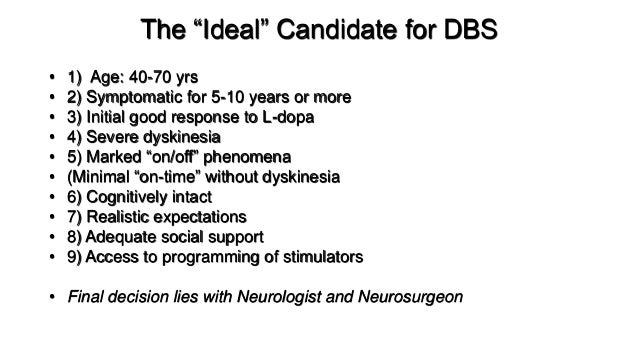
The “Ideal” Candidate for DBS
• 1) Age: 40-70 yrs
• 2) Symptomatic for 5-10 years or more
• 3) Initial good response to L-...
This is a suggested list, not a hard and fast rule.  Some places have their own criteria or worksheets to determine if you qualify.  The University of Florida has a multi-part form that is graded to see your probability of being a good patient. (here)  I can understand why they require you to be physically ready for the surgery, but I was not expecting all the questions on the mental readiness part.  Number 7 (above) Realistic expectations?  Would the surgery not work as well if I expected it to do more for me?  Number 8 - adequate social support- why?  To keep me from getting depressed if it doesn't work as well as expected?  There may be some side effects of this operation that I need to dig into more. 
 So after a couple hours of questions and a brief exam the neurologist determined that I qualify to move on. Step one, check, but I'll have to go back and ask her how realistic my expectations were.

Next up - Step Two - an MRI and examination off medication. 

Monday, April 18, 2016

Speech therapy Round 2

A frequent conversation starter between me and anyone new:
"Hi, I'm Don, glad to meet you." 
The response, "Hello Dan, It's nice to meet you."

The first few times I used to think "what is wrong with these people, can't they get my name right?"  This has been going on for about a year now. With more and more people from all walks of life thinking my name is Dan, I've decided to either do something about it or buckle to the pressure and change my name.  
 My second visit to the speech therapist was just as interesting as the first (see the previous blog for that adventure.)  It would seem my facial muscles and tongue have been taking advantage of the lower amount of signals from my brain and have been getting lazy.  The exercises my therapist gave me will help whip them into shape. Some examples:
  • Open your mouth - come-on...  wider (I'm starting to sound like my therapist!)
  • Stick your tongue out - further - feel the stretch
  • Now try to touch the tip of  your nose with your tongue.
  • Purse your lips and say ooo....
  • Now make a very wide smile and say eeee...
  • The LSVT LOUD® training was interesting .  Holding an ahhhh sound with your mouth wide open for as long as you can up to 30 seconds.  Repeat - a lot.  Then start low and ramp up to a higher pitch again holding for up to 30 seconds. Repeat.  Now reverse it and start high pitched and end low. Repeat.
Do these for a while and you can really feel it in your throat.  Just like exercising, the muscles get tired.
One of my initial signs of Parkinson's was the ability to trigger a tremor by holding my hand out straight and twisting my wrist. It's part of cogwheel rigidity.  Well, I've run into another trigger from this last exercise that's supposed to give me back some control and flexibility in my face. Scrunch your lips up like you are going to blow a kiss.  Now shift that smooch as far left as you can.  Now as far right as you can.  Do that 10 times.  When I try, I trigger a facial tremor.  I can't always get my lips to go right without some twitching and tremoring. Frustrating.

Parkinson's will continue to degrade both swallowing and speaking as well as many other symptoms. Unfortunately, the goal of these exercises for is only to prevent me from getting any worse.   Nothing yet can reverse the degradation.  
So if we can't reverse it, what's the goal?  For me, it would be to reduce the amount of people asking me to repeat something.  Short of that, it just would be nice to be called Don again.

Thursday, April 7, 2016

Parkinson's, Swallowing and the Speech Pathologist

"It's stuck,"  I thought.  For a while now I've had some difficulty swallowing consistently.  At times, it felt like the food was stuck about halfway down.  Plus there was the occasional 'went down the wrong tube' coughing fits.  None of this really worried me until I did research on the previous blog - you did read it didn't you?  Go ahead, we'll wait......
I didn't like the thought of possibly aspirating anything into my lungs which could lead to pneumonia.  To try and stay one step ahead, I set up an appointment with a Speech Pathologist.    
The exam - was really cool!  I've always been enamored by how my body works so I was really looking forward to being able to stand in front of a screen and watch as food and liquids went down my throat.  It didn't disappoint.  We started with the obligatory barium swallow. (I believe there's a reason you don't find Barium flavored ice cream, yuck.)  This was followed by several types of liquids and solids:  water, an egg salad sandwich, pudding, cracker etc.  Afterward, I got to watch as they played back each item.  In many cases, you could see that not all of the food would go down my esophagus on the first or sometimes the second swallow.  There seemed to be a little pocket where food was hanging out until I swallowed hard to force it down.  The technician did her best to explain how swallowing worked along with all the different muscles involved.  She also explained that with Parkinson's there are delays or smaller movements that interfere with the process of swallowing.  Just as I feared, this disease is affecting me here now too.
The therapy - I was recommended to see a speech and swallowing therapist to try and combat what was starting to happen.  Food getting stuck was one thing.  Aspirating food into my lungs was not the road I wanted to be on.  No, I'd like to put off pneumonia for as long as possible if not avoid it all together, please.
The therapist started by watching how I spoke and then watched as I swallowed some items.  Her comments were interesting such that I have heard Parkinson's described many different ways but this was new.  She said, "Parkinson's wants to make everything..". "Slow" I piped up.  She said "yes, but regarding muscles, it really is trying to make every movement small." When I thought about it, especially with movements of the face, the muscles really don't want to move much, therefore, your voice gets lower and sounds more slurred. In this instance, it was primarily my tongue that was not holding up its end of the bargain.
She described the tongues role in swallowing.  It's kind of the driver that gets things started down the esophagus.  In Parkinson's the tongue either moves too slowly or not completely back (or both) to properly aid in forcing food down the tube. 
So what to do.  We focused the remainder of the visit targeting swallowing as that can be most detrimental to my long-term health.  We started with:
Buttercup.  Say it out loud.  Annunciate! was the demand from my therapist now cracking the whip. (Side note: if you have a choice get a therapist that will push you and not let you fall into old habits.  I know what they are asking is hard but if it was easy we wouldn't need them now would we?) So say it with me...  BUT-TER-Cup.  If you do it right you will feel your tongue move back and forth in your mouth.  
Say Earl.  Now say it like you mean it.... Eaaaarrrl, puckering those lips.  Say it correctly and you feel the tongue hit the back of the throat. "Now give me 10 of each of these 5 times a day" was the homework assigned.   One note of caution, correctly done in the presence of others will cause laughter from family members or strange looks if you're in public.  Don't get me started on if you do these in the presence of someone named Buttercup or Earl.
There were several other suggestions she had to help prevent choking, especially with thin liquids. One was to take a short breath and slam your larynx shut by making a hup sound then hold your breath.  Now take a drink and magically the liquid goes down the correct tube.  The problem with this?  Trying to remember to do it before taking a drink.  Her recommendations at this stage of my Parkinson's was to concentrate on doing it more when my symptoms are at their worst, like when I haven't slept or at the end of the day.  

Next up - Second therapy session - working on proper diction or Who's Dan?

Featured Post

The DaTscan or how to get arrested at the dump

The DaTscan .  (click for info) Just in time for my diagnosis, the FDA approved the use of the drug Ioflupane I123.  This highlights the d...