Pages

Showing posts with label Parkinson's. Show all posts

Friday, January 17, 2020

A standpoint of status


Over the last three months, I've noticed a sharp decline in my ability to perform certain tasks.  Specifically, during the warm-up sessions at Parkinson's Boxing workouts.  Almost any coordinated movements between my hands and feet no longer happen.  If I get my feet going my hands stop and vice-versa.  Even marching in place has become nearly impossible to do.  So as I prepared a list of questions for my next neurologist appointment, I began to realize just how much functionality I had lost. I made a list of things I could no longer do and began wondering what would be the next thing to go.  I mentioned this to my wife and her comment, in return, struck a chord.  "Look at the positives", she said, "don't focus so much on the negative."  "Easy to say, hard to do", I thought.  Then it hit me, I've always been the optimist. Overly so, if you've ever worked with me on any project.  So what was different now?  I spent my career motivating others to get the desired results, now it was time to turn the tables and do something to motivate myself.  Movies, for me, have always been a good source of inspiration and motivation.  I remembered two moments that resonated, both from Apollo 13 and both from Flight Director Gene Kranz.  He was an amazing leader and can be attributed to some very motivating quotes. Who can ever forget "Failure is not an option".  That said, I'm not sure if the  lines I picked are actual quotes of Mr. Kranz or the writers of Apollo 13.  Either way though they certainly worked for me.  
Image result for apollo 13 movie kranz     
Gene Kranz (Flight Director):
"Can we review our status here, Sy, let's look at these things from a... from a standpoint of status. What have we got on that spacecraft that's good?"
Sy Liebergot (EECOM):
 "I'll get back to you, Gene."

The second quote occurs a little later as Gene overhears two NASA directors discussing the low survival chances for the crippled spacecraft:
“I know what the problems are Henry, this could be the worst disaster NASA has ever experienced.”
Gene Kranz:
“With all due respect Sir, I believe this is going to be our finest hour.

Both quotes demonstrate an ability to focus on the positives. Even when everything and everyone around you has nothing but bad news it's important to remember to find those positives.

For me, a new perspective; things could be a lot worse.  Each day is a blessing and should be lived like it.


Thursday, June 13, 2019

Battery replacement time for DBS system


Orange Safety Patrol Belt - Small

The initial installation of my DBS unit came with a non-rechargeable battery pack that was supposed to last 3-5 years. Unfortunately, the severity of my symptoms requires a higher complexity of programming and higher voltages both of which use more power resulting in the shorter life.  My battery signaled the need for replacement almost exactly at the two-year mark.  It was now decision time. Go with the same battery pack knowing that my symptoms will continue to get worse thereby draining the battery even faster. Or, go with a rechargeable battery but requiring me to make time to recharge the unit every day. My worry was whether I'd be disciplined enough to charge it every day. I think the answer to which one to get was clear.  With how quickly the initial battery drained and with the possibility of going through it even faster the next time, I decided on the rechargeable.  Additionally, there would be fewer battery replacement operations in my future since the rechargeable should last at least 10 years. Now I just had to persuade the surgeon. 
Fortunately, for me, it didn't take too much convincing.  When my neurosurgeon looked at the short life span of the original battery as well as my current and future electrical demands, he agreed that the rechargeable would be the correct choice.  He did jokingly say that if I go with the rechargeable unit, I wouldn't get to see him as much and that he would miss me. I blurted out "Don't worry, I would come visit you."  He smiled but a loud chuckle came from the nurse in the room.  She knew sarcasm when she heard it.

It's been over six months since I had the rechargeable installed and all-in-all its been a great choice. The daily recharge hasn't been an issue. I am up between 4-5 am everyday (thank you Mr. Parkinson's) and my mornings have become pretty standard: Let the cat out, make coffee, let the cat in, then sit and read for about 30-45 minutes.  It's during this time that I do the recharging.  With my current demand, 30 minutes is all I really need to maintain between 75% and 100% charged.  I've even missed a day and only dropped to 50% charge status.

The system I have is very nicely designed. Thank you to Medtronic for your engineering skills.  It's easy to use and does it's job quickly.  I simply place the recharging pad onto my skin directly over my battery and press go. The system checks the alignment and tells me how close I placed the pad to the optimum spot.  The closer you get to that sweet spot the better connection it has to the battery allowing more power to be transferred in the same amount of time. If anyone from Medtronic is reading this, it would be nice if the system told you which way to move the pad to get better alignment. The system comes with a strap so you can walk around while charging if you want.  I thought it made me look more like a crossing guard so if I do have to get up (probably to let the cat out again) I just hold the charger in place with one hand.  Oh, the recharging unit itself is portable since it is also a rechargeable battery that only needs to be recharged about once a month.  One other note that I didn't realize would be such a big benefit but actually is the best reason to get the rechargeable version.  The unit that is inserted into your body is thinner than the non-rechargeable one.  So the complaint I mentioned in a previous blog about always feeling it there when I moved around is almost completely gone.  I can lie on my side now with no tugging or it getting in the way.  Definite Bonus!

Thursday, January 3, 2019

What we've got here is a failure to communicate

I've never been a huge talker, or a medium one for that matter.  As self proclaimed King of the Introverts, I like to sit back and listen while adding just enough to keep a conversation going.  But, there's a big difference between not wanting to communicate and not being able to.  So much of our day-to-day lives depends on our ability to speak clearly and be understood. Some daily encounters may include:
Having to call the Doctor's office and schedule an appointment. Calling the pharmacy.  Run a meeting. Calling customer service because the store lost your shipment, talking to your bank or the insurance company.  The sales clerk at the store needs your phone number, or placing your order with the person behind the meat counter. These are just examples of when you know you are going to have to speak and can prepare for that moment. Unexpectedly running into someone you know, or getting a phone call that you must take are now frightening scenarios to me.    
In every instance of conversation you need to be understood. Unfortunately, Parkinson's may have other plans. For me at least, its become a huge problem, so much so, that I avoid contact where I can.  I may come across as aloof, or maybe just rude but its easier to avoid conversations when you know you wont be understood. 
So what to do?
For starters, I contacted my neurologist to make sure my DBS unit isn't the cause.  I had a thorough exam where my speech (and swallowing) were tested and retested with the unit on and off as well as my status in the medication cycle of either "on" or "off".  In my case, the DBS unit was not causing any speech or swallowing issues.
I then went back to speech therapy.  This time I tried the Speak Out Program developed by the Parkinson's Voice Project which is now available in many areas around the country.  They taught me some skills to  combat the slur that has overtaken my normal voice. They concentrate on getting your voice louder which is typical for most patients with Parkinson's.   However, my problem is more complicated and a quiet voice isn't where I am struggling right now.  It is the formation, stuttering and speed that I can't always control.  Their recommendations include slowing your speech down by thinking about each word and forming it correctly.  It does work, however I have trouble doing that AND having a conversation at the same time.  Throw on top of that another Parkinson's symptom like word finding and you'll see what I'm up against. Word finding, the occasion where you cannot think of the word even though you know the word and can describe it, is very frustrating. Take the word drain for example.  I've used that word many times and can describe its function however at that moment in the conversation where I needed to say the word.... Nothing.  I couldn't  come up with it. 
Forcing yourself to slow down and form each word makes it very difficult, for me, to have a quick conversation. The best way I can describe it is by relating to something I said years ago regarding swinging my arms when I walk.  I can do it when I think about it, but, as soon as I stop thinking about it, I stop swinging my arms.  For people that don't have Parkinson's the exact opposite is true.  Try walking and not swinging your arms and you'll see what I mean. When I think about what I want to say I forget to slow down and enunciate.
So, what do people do to try and help?  They hear your struggles and almost always try and finish your sentence for you.  Unfortunately, their idea of what I am trying to say usually isn't what I was thinking.  I've been misunderstood, and even said somethings other than what I meant just because it was they only sentence I could utter clearly at the time. I say things that I think are understood only to find out later that it either wasn't heard at all or the person got tired of asking me to repeat something and just nodded their head.  Oh, and for another level of frustration, try talking to one of those digital assistants like Alexa, Siri or Google.

I think that it would be safer if I handed out a card prior to any conversation:
Warning! - Person with Parkinson's
For those that have to interact with me, please be patient and assume nothing because you may or may not have heard me correctly.

There are 50 muscles involved in swallowing but over 100 could be used in proper speech.  With Parkinson's fighting muscle movements it seems impossible to hope that I will ever be clearly understood again.   Maybe its time to rewatch Cool Hand Luke.


Tuesday, April 17, 2018

DBS - is there a negative?

In my last post I discussed how DBS surgery has helped me continue working and allowed  the use of my left hand again.  Nothing I am going to tell you here should leave you believing that I have any regrets of having the surgery.  On the contrary, it can be life changing but its not free, figuratively or otherwise.

Image result for free to use negative clipart
The negatives:
1) The procedure - It is not painful however it is long. Once you are 'framed' into that chair you aren't moving for 5-6 hours.  There are plenty of people around you to help you get comfortable.  My back started to bother me and my legs got real jumpy by the end.  I think my body had enough.  Not a big fan of catheters either.  There was no pain when they implant the temporary posts to hold the frame to your head or when they were removed.  The hospital staff does a tremendous job of trying to keep you comfortable.  It's just that it is a long procedure and it does drain you. 

2) The battery implant - The battery pack is just plain annoying, even after nearly 2 years with it. Most of the time you don't really realize you have it but when you reach across your body for something, a little tug reminds you it's there. When you lay on your side it gets squished and uncomfortable.  It doesn't hurt you just know its there.  Bothersome is probably a better word. Also, it does wear out.  I haven't had to replace mine yet, I'm guessing by year three, but it does require another day-surgery when it comes time. I'm opting for the rechargeable one next.  I hope to get 10 years out of that one. 

3) The adjustments - It takes months to tune in the device as everyone's symptoms are different and there are hundreds of combinations of settings to go through to give you the best benefit. Even then, my symptoms aren't the same everyday or even the same throughout the day so, it's a bit of what's best in general.  My biggest problem with the adjustments is every time I have one scheduled, that day for some reason, I am at my absolute best. FRUSTRATING!  My neuro still manages to dial it in enough plus gives me enough adjustments in the remote to compensate for fluctuations.  

4) The cost - You need decent insurance for this surgery.  Typically its between $50-60k for the surgery then the follow-up visits are every 3 months for a while until it goes to twice per year.  Travel, time-off for surgery and appointments, plus the cost of the appointments themselves can get expensive.

5) The limitations - Its not a miracle cure for all that ails you.  In my case it works extremely well for the tremors and the slowness of movement I was having in my left hand.  Unfortunately, as you read in my previous blogs, there are over 80 symptoms that Parkinson's can cause.  Your Doctor will determine the best placement, probe and settings to control the worst of your symptoms but you will still have symptoms. Additionally, it doesn't slow the progression of the disease.  Its not meant to be thought of as a cure, more of a crutch.  What it can do it does very well but there are limitations.

6) The future - If you need it, you need it.  You can wait for the next best thing to come out (and it does and just did).  However, what they have out now works very well for the symptoms it can control.  Plus, its a proven surgery with thousands of success stories.  Don't let anything get in your way of being the best you can for as long as you can.

No one knows your future or how quickly you are going to progress.  In my case, I went from diagnosis to having the surgery in 5 years. I'm guessing that's because my Neuro called my disease "aggressive".  Yours will most definitely be different.  Listen to your Doctors, if you don't trust them find someone you do.  Even with the negatives I've listed, this surgery can give you back a part of your life you may have already thought you've given up. 

Friday, March 16, 2018

DBS after 2 years

It's hard to believe that it is coming up on two years since my implantation surgery.  Sounds weird saying it like that, "implantation surgery" and for you Star Trek fans, sounds very Borg-like.

So how has it been?  Initially, I would say very good.  I believe it is the sole reason I have been able to continue working at my job.  The initial tweaks removed the dystonia and painful cramping in my hand and eliminated my tremors.  DBS does those things very well.  However, as my symptoms fluctuate and constantly progress the system is having a harder time compensating or keeping up, as it were.  Each probe has so many adjustments that the tweaking could be endless, but, that's a good thing.  More, finer adjustments means longer adjustment appointments, however it gives the neurologist the ability to find the 'sweet-spot" with less side effects. My problem with the programming adjustments is that for some reason, I am always at my best when I see the Neurologist.  She makes these adjustments and asks how I feel.  "Great" always seems to be the answer but then I came in feeling great too. Just once I like to be seen at my worst - "There, adjust me now!"
One of the drawbacks to the surgery is the area they need to simulate is very near other important areas in the brain.  Not much room in there.  If my settings get adjusted too high, I get what can best be described as "leakage" into a nearby area.  In my case leakage into the area controlling facial muscles. This causes a noticeable slur of my words which when I'm "on" is fine and hardly noticeable.  But, when I'm sliding down to "off- state"  I am very difficult to understand and frankly get so frustrated I just make it worse. My Parkinson's symptoms tend to fluctuate day-to-day as well as throughout the day.  So expecting a device that sends out a distinct and constant pulse to keep up with all the changes is not something I would expect it to be able to do.  But, that said, when my meds are working, the DBS unit does a remarkable job.

So the big question remains "was it worth it?"  Absolutely.  The main reason I had the surgery was an almost useless left hand.  The tremor control was a bonus.  In some ways, now that my symptoms have progressed to both sides of my body, my left hand is more useful than my right.  I will have to work on that with at my next adjustment appointment.  
Next up:  Some of the negatives of the Surgery

Thursday, July 28, 2016

DBS - Step Two in the approval process

After making it through the initial qualification for Deep Brain Stimulation (DBS - see my last post), I prepared for step two, evaluation without and with medication.  Sounds easy enough, no meds for 12 hours previous to the exam then get to the Doctor's office and get evaluated.  Unfortunately, I forgot a couple of things.

1) I haven't been completely off medications for a while so I forgot how difficult simple tasks can be
2) Since this is a progressive disease I really had no idea how bad I would be.

I did think ahead a little bit though and got a hotel near the Doctor's office so I wouldn't have to make the 2-hour trip while unmedicated.  As it turned out, that would be the least of my problems.
About an hour past my reminder to take my next dose of meds I started tightening up.  My left foot was dragging and my face felt like it weighed 10 pounds.  I could tell my speech was starting to struggle so I reviewed my exercises from my last therapy appointment to avoid any awkward moments checking in to the hotel.
I made it to my room and as I lay there watching the Yankees get beat up on TV (again) things started happening fast.  I was getting weird spasms in my arms and legs.  My restless leg was now in high gear and my movements had slowed to a crawl.  Then the aches started and I knew it was going to be a long night.  Just how long, I was unprepared for because no matter what I did, positions I tried, or place I attempted to lie (bed, chair, floor) I couldn't sleep.  It would be a long night.  Lucky for me there was some good TV to watch (thank you Fraiser and the movie Monuments Men).  This got me through to morning as my night went from lying down to sitting up to pacing and back to lying down as I tried desperately to get comfortable.  I thought to myself "Well, the Docs going to get me at my worst for sure.  I took a shower and headed out for some coffee hoping it would work its miracle and keep me awake through the testing.
If you've ever taken your car in for service you have probably experienced this.  The car is making a strange noise.  Ever time you do 'this' with the car it makes the same noise so you take it to a mechanic.  He gets in the car and like magic, there is no noise.  Well, after the coffee and moving around outside for about an hour that's how I felt going into this appointment unmedicated.  As bad as my symptoms were the night before they were much calmer by the time I got to the appointment.  The Parkinson's was still there but, not in the nearly institutionalized, spasmatic version they appeared to have me in the night before.  "That's common," Dr. Burack (my new neuro for DBS) told me. Apparently, the withdrawal from both Amantidine and Sinemet can cause the pain and spasms I encountered.  I didn't like the thought of being 'hooked' on a drug but at this point I have little choice.  Hopefully the DBS surgery can reduce my need for some of the 18 pills per day I am now taking.  
The exam was typical of every other neurological exam for Parkinson's except you get to do it twice.  Once off meds and again after your meds have kicked in.  Since it takes my body almost 45 minutes to an hour for the medications to work their magic it gave me the opportunity to  ask a lot of questions about latest techniques, probe placement, what the day of surgery is like, etc.  I will share these in an upcoming post.  
On to Step 3

Monday, May 16, 2016

Deep Brain stimulation - DBS from the patient perspective

It astounds me how the progression of an idea works. I mentioned this in an earlier post but I think it's worth noting again.  Somebody at some point looked at a calf getting milk from its mother and thought, "hmmm, I wonder if we could drink that."  The same applies to other things like coffee and chocolate - "Let's do these 19 steps to this bean and we might have something good in the end."  The discovery of something new and the progression of how it got to that point intrigues me.  Somewhere along the line, someone witnessed what happens when an electrical charge is given to the brain. They applied that information to invent a procedure that today has been performed over 250,000 times.  Amazing.
There are plenty of sites that describe what Deep Brain Stimulation (DBS) is and how to take one for a test-drive.  I thought I would do something a little different and tell you about it from the perspective of someone going through it.  Namely...me.

How the thought of DBS even got in the discussion.
I always thought DBS was in my future.  I figured by the 10-year mark of my diagnosis my symptoms would progress enough and the technology would advance enough for me to have the surgery.  Well, here I sit at the 5-year mark contemplating DBS pros and cons.  In my last PPMI visit with my neurologist, Dr. Richard, and her assistant Paul DeRitis at the Univerisity of Rochester, we discussed the dystonia (distortion) and bradykinesia (slowness) still hindering my left hand.  On medication, my hand will open and close albeit VERY slowly making it difficult if not impossible to use.  Fine motor skills like picking up screws or nails to work around the house cannot be done.  Off meds, my hand curls closed like a hook and is useless. Our discussion centered around my medication regime and if there was anything else that could be adjusted.  I'm maxed out on Carbidopa/Levodopa as any more and I start to get the rolling wave of dyskinesis starting with my head and working its way down to my torso.  Nothing on the scale of Michael J Fox but dyskinesis none the less. Other Parkinson's meds are a no-go due to the side effects associated with impulsivity.  So Botox was mentioned.  The premise here is there are two muscles involved in most movements.  One pulling and one relaxing - think bicep verses triceps.  The thought is to inject Botox into the muscle of my hand to relax it so it won't form my hand into a hook. A couple of problems with this procedure: One - it only lasts a few months and you have to get reinjected.  Two, it weakens the muscle.  I'm already struggling opening things like Ziploc and Potato chip bags.  If this makes it worse I'll really be in trouble. I wasn't getting a good feeling about this procedure so I asked what else we could do. This is where they suggested I consider DBS surgery.

DBS appointment - Step one
With the anticipation of going down the DBS route, I get to add another neurologist and now a neurosurgeon to my repertoire of medical professionals. Dr. Richard and Paul are phenomenal and if you're near upstate NY I highly recommend you seek them out.  However, now I get to deal with another highly regarded movement disorder specialist, Dr. Burack also of the University of Rochester.   The new neurologist works in tandem with the neurosurgeon to perform the DBS surgery. While the surgeon is doing the cutting and insertion of the electrodes, the neurologist is directing the precise location and final placement.  I'm getting ahead of myself though.  Step one is to meet with the new neurologist to see if you qualify for surgery.  Apparently, to qualify for DBS you have to meet certain criteria.  
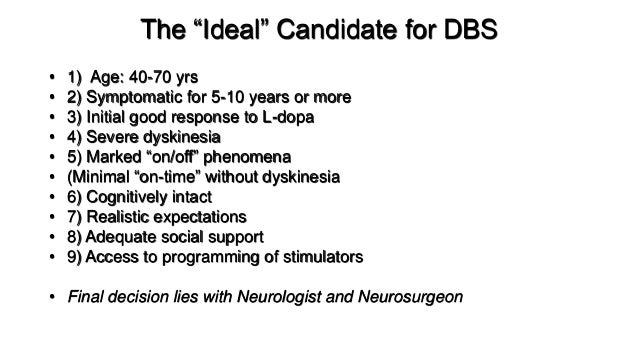
The “Ideal” Candidate for DBS
• 1) Age: 40-70 yrs
• 2) Symptomatic for 5-10 years or more
• 3) Initial good response to L-...
This is a suggested list, not a hard and fast rule.  Some places have their own criteria or worksheets to determine if you qualify.  The University of Florida has a multi-part form that is graded to see your probability of being a good patient. (here)  I can understand why they require you to be physically ready for the surgery, but I was not expecting all the questions on the mental readiness part.  Number 7 (above) Realistic expectations?  Would the surgery not work as well if I expected it to do more for me?  Number 8 - adequate social support- why?  To keep me from getting depressed if it doesn't work as well as expected?  There may be some side effects of this operation that I need to dig into more. 
 So after a couple hours of questions and a brief exam the neurologist determined that I qualify to move on. Step one, check, but I'll have to go back and ask her how realistic my expectations were.

Next up - Step Two - an MRI and examination off medication. 

Sunday, January 10, 2016

The C word

Among the few benefits there was to having Parkinson's Disease had been the theory that along with the diagnosis comes a reduction in the likelihood of getting most cancers. Recently, however, various studies have been poking holes in that belief. While the debate still goes on as to whether Parkinson's helps or hurt certain cancer formations all conclude that Parkinson's Disease patients have a MUCH higher rate of skin cancer than the 'normal' population. From double to nearly four times more likely depending on who you listen to.  So after conversing with my neurologist, her recommendation was to get an examination by a dermatologist and repeat them yearly.

With that knowledge, I immediately called the dermatologist office to set up the appointment - Ugh, six-week wait.  If you've read some of my earlier posts you would know that I don't wait very well.  If there is something that needs to be checked I want to do it now.
The wait went quicker than expected with Christmas and New Years acting as a nice diversion and now it was appointment day.  The exam was pretty quick also. Under a magnifying glass, the dermatologist examined anything that looked other than what could be called normal skin.  She called out what she saw to a waiting nurse that diligently clicked away on the computer capturing all my abnormalities. The dermatologist did reassure me that even though some of the words she used sounded a bit frightening what she is seeing are just normal things one finds on the skin of a 50+ year-old person.  That is until....she gets to the back of my neck.  "Hmmm", she says, "tell me about his mole on the back of your neck."  Not exactly the words you want to hear when they are examining you for skin cancer. So a quick poke for a sample (actually a biopsy but the word sounds much more ominous than sample) and off to the lab it goes.  7-10 days until diagnosis. Great, more waiting.  As I said, I don't do that very well.

The information is somewhat muddled out there on whether having Parkinson's Disease helps or hurts you with the rate of getting cancer.  Some studies show a reduction of some types of cancer while others show an increase in others.  Overall though, the message is pretty clear: Skin Cancers, especially melanomas are increased with having Parkinson's.  So to my Parkie friends out there, please go and get yourself examined.  It's quick and painless and if they find something early on it is 100% treatable.


Good Article here- describing the connection between Parkinson's and skin cancer

An article describing reduced risk of some cancers (non-skin type) - here

Recent study claiming higher incidence of 16 types of Cancer in Parkinson's patients here

Excellent guide here for dealing with melanoma's  - 

Sunday, December 20, 2015

The weirdness that is Parkinson's Disease

     While researching the symptoms of Parkinson's Disease for the last two blogs, I started to think about all the weird maladies I was experiencing in the years leading up to my diagnosis. Some were more strange than others and none, even now, seem related to Parkinson's.  However, I wonder how many could have been caused by my brain trying to cope with the slow closure of the dopamine tap. 

     All of these symptoms would come and go.  Some lasting for weeks or months while others lasted for years before going away.  That's one reason I am having a problem figuring out if any of this is related.  I would think once you have a certain symptom you would continue to have it.  Maybe not all the time, but it should pop back in now and again wouldn't you think?  
     I'll start with the weirdest first and I guess it could be classified under vivid dreams.  About 10 years before I was diagnosed, I was terrorized by dreams about spiders.  Not a dream where something was happening and spiders were in there too.  No, these were dreams of me lying in bed and seeing spiders dropping down from the ceiling onto the covers.  I would jump out of bed throw the covers back and flick the light on.  My heart would feel like it was coming out of my chest as I agonized over where they went.  Surprisingly, this would wake my wife up every time. She would calmly tell me it was just a dream and go back to sleep, but it was so real I'd be up for a while.  This would repeat a couple times a month for about a year and then they thankfully stopped.  I remember telling my Mom about this and she said dreams about spiders aren't a good sign.  They usually mean something bad is about to happen.  Once again, Mom you were right!
If that wasn't strange enough, keep reading, I only get weirder from here.
    A lot of research is coming out about how Parkinson's affects the eyes.  This one I haven't shared with anyone before now because it is so strange.  Picture yourself driving down a country road and everything seems fine as you stare straight ahead.  Then suddenly, everything in your field of view rotates to the right about 30 degrees. You were looking straight down the road before but now you are looking at the left shoulder of the road.  Keep in mind you never moved your eyes or your head.  Its just that the spot you were focused on has been picked up and moved. It would be like you are staring at this blog then suddenly the scene rotates and you're staring at your left arm yet you never moved anything.  It's only happened twice, thankfully, and I have no idea if it's related to Parkinson's, but it would be interesting to find out. 
     There were more strange things happening to me prior to diagnosis that to this day remain unexplainable. I'll share just a couple more at the risk that by confessing any additional publically the men with the white suits may come and toss me into the back of a rubber truck. (Yes, that was a MASH reference),   I don't know if these symptoms will ever be linked to Parkinsons or anything else for that matter, but they happened.  Things like sweating profusely but just under one arm.  Luckily for me (and anyone that stood near me) this only lasted a short time. Also, allergies that have seemed to have come and gone are another one.
     I should retitle the main blog "The weirdness that is Parkinson's". Or, maybe this isn't related at all and I'm just a little batty, but seems odd that all these symptoms would attack an otherwise healthy person.
  
P.S. Four shopping days left till Christmas.  Remember when Sundays weren't counted in the shopping days calculation?

Monday, November 30, 2015

Parkinson's symptoms - 70 and counting Part 2

Part 2 of my look into the symptoms of Parkinson's Disease.  If you know of any I missed please forward information and I will look into adding it.  This list contains items I've found to be caused by Parkinson's, or at least according to the attached link for each one.  By no means is it meant to be exhaustive or a diagnosis.  
I was really amazed by the number of vision problems that Parkinson's can cause.  I had no idea of the association but will definitely bring the list with me next time I visit the ophthalmologist.


MOTOR

We begin with the four tenets of Parkinson's Disease:


Musculoskeletal


  • Micrographia - my writing is nearly illegible now.  Makes writing out cards nearly impossible
  • Dystonia - a disease in itself however Parkinson's and especially Parkinson's meds exacerbate the condition
  • Myoclonus-a quick, involuntary muscle jerk. I get these occasionally and they can happen anywhere in my body.  I've had them most while drifting off to sleep. 
Postural deformities

  • Difficulty turning in bed
  •      difficulty standing from chair/car
  • Dysphagia - difficulty swallowing

  • Sialorrhea -increased saliva production leading to drooling - I've seen this placed in the non-motor group but it seemed a better fit for my list here.
  • Hypomimia (masked facial)


Gait


Vision


Speech
Speech disturbances (hypokinetic dysarthria)
Hypophonia: soft speech.
Monotonic speech: Speech quality tends to be soft, hoarse, and monotonous
Festinating speech: excessively rapid, soft, poorly-intelligible speech.

Urinary
difficulty holding - I hate that sudden 'attack' of I have to go NOW!
difficulty emptying


Other Akathisia: an unpleasant desire to move. restless leg?

Monday, November 16, 2015

Parkinson's Symptoms - 70 and counting Part one


What do you picture when you think of a person with Parkinson's?  Tremors, slow movement, shuffled walk, the basics I guess.  I was surprised to find how full bodied this disease actually can be.  It seems to affect nearly all portions of the body in some way. 
 Since the more I looked the more I found, I started making a list.  It grew and grew to a point that I decided to share this.  It was becoming larger than I every imagined.  To date, my list includes over 70 items linked to Parkinson's Disease.  I've split them into two groups, Motor and non-motor.  This post will cover the Non-Motor symptoms.  I've attached  reference for each symptom listed so click away for more information. However, keep in mind that everyone is different and if you're afflicted with Parkinson's you may get some combination of these symptoms and not necessarily all of them.
If you know of any additional symptoms or question anything listed I'd love to hear from you.

Non-MOTOR

Hallucinations and also here
Confusion - delusions/paranoid overtones
Cognitive dysfunction - executive
Dementia
Short term memory - recent events
Difficulty making decisions
Multi-tasking
Visuospatial skills difficulties judging distances
Slowed cognitive speed (Bradyphrenia).
Language dysfunction and also here
Attention difficulties
Psychosis
Impulse control

Mood disorders
depression
anxiety
apathy/abulia
anhedonia
fatigue
Alexithymia -  a personality trait characterized by difficulties identifying and describing feelings and a reduced tendency to think about emotions.

Sleep disturbances
Sleep fragmentation
Initial Insomnia
Excessive daytime sleepiness - somnolence.
REM sleep behavioral disorder (RBD) - vivid dreams, acting out

Autonomic dysfunction
Urinary urgency/frequency
Constipation and also here
Orthostasis
Sexual dysfunction and/or lack of interest 
Excess perspiration - abnormal sweating
Difficulty swallowing

Smell
Olfactory dysfunction
   lack of smell
   phantom smells

Dermatological
Seborrhea
Oily skin

Monday, November 9, 2015

Next blog coming but check this book out in the meantime


Here is a link to a great cartoonist with Parkinson's Disease, Peter Dunlap-Shohl.  He has written a book in cartoon form about what it's like to experience and cope with having Parkinson's.  

A sample and link here

and another here

and you can order it here

My next post is taking a while.  It's on all the symptoms including links associated with or caused by Parkinson's.  I'll have to split it into two posts because as it stands today there are over 70!.

Tuesday, October 27, 2015

Apathy - the curse of Parkinson's

I started writing this blog as a kind of therapy for me to deal with the symptoms of Parkinson's Disease.  What I have found it most useful for, however, is a driver to get me moving and doing something... anything... other than sitting like a veg in front of the TV.
I used to be driven.  I used to have passion.  I would work on a project from sun-up till sundown and even later sometimes. It was almost like an obsession.  I couldn't wait to get started then drove myself to get as much of it done at one time as I could.
Then Parkinson's started to work its magic.  I've lost that edge, that drive and the will to accomplish, well.... anything.

I find myself frequently unmotivated. Just willing to do the bare minimum to get through the day. Projects I used to love to do, like working on my 100-year-old house, do nothing to excite me like they used to. I have to will myself off the couch just to get started and easily could be convinced to sit idle and watch reruns on TV instead.  Surprisingly, when I do manage to get going and accomplish something, I always feel better. You would think that would motivate me the next time, but sadly no.
At first I thought, along with the myriad of other symptoms of Parkinson's, I was falling into depression. Some studies suggest that 60% of people with Parkinson's experience mild to moderate depressive symptoms. I didn't feel depressed so my neurologist clarified this with a simple example.  She described meeting with a couple where the wife was concerned that the husband was depressed.  The wife stated the husband was unmotivated, didn't enjoy things anymore and basically wanted to sit on the couch all day.  The neurologist turned to the husband and asked him how he felt.  "I feel good" was the response.  Her opinion: This would most likely be apathy, not depression.  While not a clinical diagnosis, it certainly does help clarify the picture.


The best description of apathy and treatment options I've found is here.


Unfortunately, while there are many options available to treat depression, they are still trying to find the right combination that will treat apathy. And, as with most medications, you have to be careful of the potential side effects which rule out most of them for me.
While doing some research, I did stumble across yet another depressive symptom related to Parkinson's which I found interesting.  Well, interesting to me because it explains what I'm feeling (or not) better than anything else I have ever found. 

Anhedonia -  the inability to experience pleasure from activities usually found enjoyable

I have found over the years that I've been more and more of a 'what's next' kind of guy.   When something good happens to me, like winning an award or finishing a big project all I can think of "okay, that's over, what's next?"  It isn't that I'm unhappy that I accomplished something, there's just no sense of joy.  The strange part is this seems to be a bigger problem for those around me than it is to me. I guess it should bother me more, but it doesn't.  Hmm, indifference.  Strike another one up for apathy.
I've said it several times now, this is a weird disease.  At least it keeps me busy looking up new problems.

Some additional links on Apathy

Apathy vs depression here
Some non-medication tips for dealing with apathy here
Apathy and cognitive function here
Interesting study on apathy and other neuropsychiatric symptoms here
A little on anhedonia here

Saturday, October 17, 2015

Is there anything good about Parkinson's? - Chocolate!


Have you ever had a craving?  I don't mean, "gee I could go for a bowl of ice cream" craving.  I mean the 10 pm it's snowing outside and I'm headed to the store because I need a piece of chocolate kind of craving.
It's a strange feeling that overtakes you and it all goes away with a little chocolate.  I don't want the whole bar, just enough to satisfy the craving. I'm not sure if any of my Parkie friends have experienced this feeling with this or any other food, but I find it strange that the craving stops with with just a square or two and I'm not driven to eat the whole bar.

How did the Mayans or whoever actually invented chocolate think ' if I just do these 12 steps these inedible bitter beans become something delicious!"  This is what I think about staring at the ceiling at 2 am, but I digress.

Chocolate contains many compounds, (nearly 380!!) that stimulate dopamine and other 'feel good' chemicals or prevent their reabsorption. Here is a short list of some of them and their effects:
  • Tryptophan and serotonin: They create feelings of relaxation and well-being.
  • Caffeine: creates temporary alertness.
  • Xanthines: like caffeine, increases wakefulness.
  • Theobromine: A stimulant and vasodilator increases blood flow.
  • Phenylethylamine: stimulates the brain to release dopamine,
  • Anandamide: This neurotransmitter activates pleasure receptors in the brain.
  • Flavonols: Found also in foods like red wine, blueberries and green tea, these compounds boost blood flow to key areas of the brain for two to three hours after being metabolized, creating effects similar to those of a mild analgesic (painkiller) like aspirin.  reference here
 Okay, I get the attraction, but other foods produce dopamine and you don't see me driving to the store in the cold night air to pick up fava beans!  Plus, the amount of these chemicals in chocolate is incredibly low.  One study suggested it would take 25 lbs of chocolate to get that 'high' feeling.  So how could a couple of small pieces satisfy a craving?  Reading what is out there all I can suggest is the brain senses an imbalance, triggers the craving and once the craving is satisfied turns the craving back off.  I've said it before, this disease is weird.  At least, though, it was kind enough to make me crave chocolate and not something gross like... raisins...ick, I get a shiver just thinking about it.

Oh, my chocolate of choice - Hershey's Symphony bar - best chocolate you can get for under $2.  I am open to suggestions, though.

Interestingly enough, there's about the same number of studies telling you how chocolate leads to Parkinson's as there are stating how chocolate helps Parkinson's patients.  I broke some down below and will let you decide.


Bad Chocolate
Over-consumption leads to Parkinson's here
Compound inside Chocolate causes Parkinson's here
Chocolate doesn't help Parkinson's sufferers here

Good Chocolate
Study to find if chocolate reduces symptoms here and here
Benefits of Cacao here  and here

Avoid chocolate? here


Up next:  Apathy......maybe

Thursday, October 8, 2015

Sleep... I took you for granted all these years

It is getting late and I am falling asleep in the recliner.  Time to give up and go to bed.
I lie down and like magic I am... wide awake.  Maybe if I just toss and turn for a while I'll tire myself out.  60 minutes, 90 minutes.  Nope, not happening...get back up.
Wide awake now,  let's see.... surf internet, check mail, write a little in next week's blog, bored.... I wonder what's on TV?  Infomercials. A combination banana slicer, cheese-grater and corkscrew.  I might have to get me one of those.  OOH, buy 1 now get 2 free!  I see why these shows are on in the middle of the night.  That's when we are at our weakest.
Finally feeling sleepy enough to go back to bed.  Dog took my spot, figures. 
Sleep.  Weird dream, wow that was so REAL!  Eyes snap open.  Feels like it should be morning by now.  Nope, 3 am.  Maybe if I could just get comfortable. Toss and turn again, ugh, now 4 am.
I wonder if I should just get up.
Hmmm, now it's almost 5 am, I must have dozed off briefly.
5:30 am alarm goes off.  I'm dragging.  It feels like I could sleep for hours.  At last, the sleepy feeling I've been waiting for has come.  It's not fair that it arrives just when I have to get up.

To sleep, perchance to dream; ay, there's the rub

I know Shakespeare's Hamlet was talking about suicide in this quote, but it has a different meaning to Parkies.  You can't get to sleep and when you finally do you can't stay asleep.  But, when you do happen to drift off, your sleep is either filled with vivid dreams or you act out one of them and punch your water bottle off the nightstand. Ay, there's the rub!
I can't remember the last time I had a good nights rest. For a while now it has been very repeatable:
  • can't get to sleep will last a few days to a week
  • can get to sleep, but can't stay asleep takes over for about another week
  • then can't get to sleep and can't stay asleep hits which basically means you are up all night
then the cycle starts again

Nothing has worked.  Melatonin, sleep aids like zzzQuil, sleepy time tea, warm milk, a jug of wine, nothing will break the cycle.  I am able to get by at least a little more comfortable by taking a Sinemet CR (controlled release) right before bedtime.  This helps to stave off the muscle soreness that would wake me up or prevent me from getting into a deeper sleep. However I am still, at best, getting 4-5 hours sleep a night and usually that's not all in a row.
I can't offer a lot of advice on this subject because I haven't figured it out myself yet.  I have gone through the no alcohol, no caffeine, no tv routines to try and help me get to sleep. Plus, tried no computer screens when I am up in the middle of the night to keep from 'waking my brain up'.  Nothing helps.  When I am up...I'm up.  At those moments, my body has no intention of resting so I figure I might as well be productive and get some work done.  I look forward to retirement someday where, hopefully, at two in the afternoon,  if I want a nap I can take one!

Here are some links to keep my Parkie friends busy in the middle of the night:


What lack of sleep does here  
Why you need your sleep here
Effects of not getting enough sleep infographic here

An article from the Huffington Post on continued poor sleep here
Interesting take from Business Insider here

Sleep tips from Parkinson's Canada here

Acting out while sleeping here
REM sleep disorder and Parkinson's here

Why can't a Parkie sleep? here

Can't sleep? You are not alone here

Data from a sleep study here


Next up: Is there anything good about Parkinson's - Chocolate!

Featured Post

The DaTscan or how to get arrested at the dump

The DaTscan .  (click for info) Just in time for my diagnosis, the FDA approved the use of the drug Ioflupane I123.  This highlights the d...