After making it through the initial qualification for Deep Brain Stimulation (DBS - see my last post), I prepared for step two, evaluation without and with medication. Sounds easy enough, no meds for 12 hours previous to the exam then get to the Doctor's office and get evaluated. Unfortunately, I forgot a couple of things.
1) I haven't been completely off medications for a while so I forgot how difficult simple tasks can be
2) Since this is a progressive disease I really had no idea how bad I would be.
I did think ahead a little bit though and got a hotel near the Doctor's office so I wouldn't have to make the 2-hour trip while unmedicated. As it turned out, that would be the least of my problems.
About an hour past my reminder to take my next dose of meds I started tightening up. My left foot was dragging and my face felt like it weighed 10 pounds. I could tell my speech was starting to struggle so I reviewed my exercises from my last therapy appointment to avoid any awkward moments checking in to the hotel.
I made it to my room and as I lay there watching the Yankees get beat up on TV (again) things started happening fast. I was getting weird spasms in my arms and legs. My restless leg was now in high gear and my movements had slowed to a crawl. Then the aches started and I knew it was going to be a long night. Just how long, I was unprepared for because no matter what I did, positions I tried, or place I attempted to lie (bed, chair, floor) I couldn't sleep. It would be a long night. Lucky for me there was some good TV to watch (thank you Fraiser and the movie Monuments Men). This got me through to morning as my night went from lying down to sitting up to pacing and back to lying down as I tried desperately to get comfortable. I thought to myself "Well, the Docs going to get me at my worst for sure. I took a shower and headed out for some coffee hoping it would work its miracle and keep me awake through the testing.
If you've ever taken your car in for service you have probably experienced this. The car is making a strange noise. Ever time you do 'this' with the car it makes the same noise so you take it to a mechanic. He gets in the car and like magic, there is no noise. Well, after the coffee and moving around outside for about an hour that's how I felt going into this appointment unmedicated. As bad as my symptoms were the night before they were much calmer by the time I got to the appointment. The Parkinson's was still there but, not in the nearly institutionalized, spasmatic version they appeared to have me in the night before. "That's common," Dr. Burack (my new neuro for DBS) told me. Apparently, the withdrawal from both Amantidine and Sinemet can cause the pain and spasms I encountered. I didn't like the thought of being 'hooked' on a drug but at this point I have little choice. Hopefully the DBS surgery can reduce my need for some of the 18 pills per day I am now taking.
The exam was typical of every other neurological exam for Parkinson's except you get to do it twice. Once off meds and again after your meds have kicked in. Since it takes my body almost 45 minutes to an hour for the medications to work their magic it gave me the opportunity to ask a lot of questions about latest techniques, probe placement, what the day of surgery is like, etc. I will share these in an upcoming post.
On to Step 3
Thursday, July 28, 2016

Monday, May 16, 2016
Deep Brain stimulation - DBS from the patient perspective
It astounds me how the progression of an idea works. I mentioned this in an earlier post but I think it's worth noting again. Somebody at some point looked at a calf getting milk from its mother and thought, "hmmm, I wonder if we could drink that." The same applies to other things like coffee and chocolate - "Let's do these 19 steps to this bean and we might have something good in the end." The discovery of something new and the progression of how it got to that point intrigues me. Somewhere along the line, someone witnessed what happens when an electrical charge is given to the brain. They applied that information to invent a procedure that today has been performed over 250,000 times. Amazing.
There are plenty of sites that describe what Deep Brain Stimulation (DBS) is and how to take one for a test-drive. I thought I would do something a little different and tell you about it from the perspective of someone going through it. Namely...me.

How the thought of DBS even got in the discussion.
I always thought DBS was in my future. I figured by the 10-year mark of my diagnosis my symptoms would progress enough and the technology would advance enough for me to have the surgery. Well, here I sit at the 5-year mark contemplating DBS pros and cons. In my last PPMI visit with my neurologist, Dr. Richard, and her assistant Paul DeRitis at the Univerisity of Rochester, we discussed the dystonia (distortion) and bradykinesia (slowness) still hindering my left hand. On medication, my hand will open and close albeit VERY slowly making it difficult if not impossible to use. Fine motor skills like picking up screws or nails to work around the house cannot be done. Off meds, my hand curls closed like a hook and is useless. Our discussion centered around my medication regime and if there was anything else that could be adjusted. I'm maxed out on Carbidopa/Levodopa as any more and I start to get the rolling wave of dyskinesis starting with my head and working its way down to my torso. Nothing on the scale of Michael J Fox but dyskinesis none the less. Other Parkinson's meds are a no-go due to the side effects associated with impulsivity. So Botox was mentioned. The premise here is there are two muscles involved in most movements. One pulling and one relaxing - think bicep verses triceps. The thought is to inject Botox into the muscle of my hand to relax it so it won't form my hand into a hook. A couple of problems with this procedure: One - it only lasts a few months and you have to get reinjected. Two, it weakens the muscle. I'm already struggling opening things like Ziploc and Potato chip bags. If this makes it worse I'll really be in trouble. I wasn't getting a good feeling about this procedure so I asked what else we could do. This is where they suggested I consider DBS surgery.
DBS appointment - Step one
With the anticipation of going down the DBS route, I get to add another neurologist and now a neurosurgeon to my repertoire of medical professionals. Dr. Richard and Paul are phenomenal and if you're near upstate NY I highly recommend you seek them out. However, now I get to deal with another highly regarded movement disorder specialist, Dr. Burack also of the University of Rochester. The new neurologist works in tandem with the neurosurgeon to perform the DBS surgery. While the surgeon is doing the cutting and insertion of the electrodes, the neurologist is directing the precise location and final placement. I'm getting ahead of myself though. Step one is to meet with the new neurologist to see if you qualify for surgery. Apparently, to qualify for DBS you have to meet certain criteria.
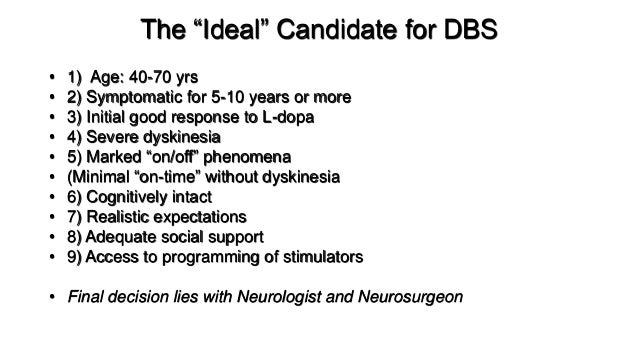 This is a suggested list, not a hard and fast rule. Some places have their own criteria or worksheets to determine if you qualify. The University of Florida has a multi-part form that is graded to see your probability of being a good patient. (here) I can understand why they require you to be physically ready for the surgery, but I was not expecting all the questions on the mental readiness part. Number 7 (above) Realistic expectations? Would the surgery not work as well if I expected it to do more for me? Number 8 - adequate social support- why? To keep me from getting depressed if it doesn't work as well as expected? There may be some side effects of this operation that I need to dig into more.
So after a couple hours of questions and a brief exam the neurologist determined that I qualify to move on. Step one, check, but I'll have to go back and ask her how realistic my expectations were.
Next up - Step Two - an MRI and examination off medication.
There are plenty of sites that describe what Deep Brain Stimulation (DBS) is and how to take one for a test-drive. I thought I would do something a little different and tell you about it from the perspective of someone going through it. Namely...me.

How the thought of DBS even got in the discussion.
I always thought DBS was in my future. I figured by the 10-year mark of my diagnosis my symptoms would progress enough and the technology would advance enough for me to have the surgery. Well, here I sit at the 5-year mark contemplating DBS pros and cons. In my last PPMI visit with my neurologist, Dr. Richard, and her assistant Paul DeRitis at the Univerisity of Rochester, we discussed the dystonia (distortion) and bradykinesia (slowness) still hindering my left hand. On medication, my hand will open and close albeit VERY slowly making it difficult if not impossible to use. Fine motor skills like picking up screws or nails to work around the house cannot be done. Off meds, my hand curls closed like a hook and is useless. Our discussion centered around my medication regime and if there was anything else that could be adjusted. I'm maxed out on Carbidopa/Levodopa as any more and I start to get the rolling wave of dyskinesis starting with my head and working its way down to my torso. Nothing on the scale of Michael J Fox but dyskinesis none the less. Other Parkinson's meds are a no-go due to the side effects associated with impulsivity. So Botox was mentioned. The premise here is there are two muscles involved in most movements. One pulling and one relaxing - think bicep verses triceps. The thought is to inject Botox into the muscle of my hand to relax it so it won't form my hand into a hook. A couple of problems with this procedure: One - it only lasts a few months and you have to get reinjected. Two, it weakens the muscle. I'm already struggling opening things like Ziploc and Potato chip bags. If this makes it worse I'll really be in trouble. I wasn't getting a good feeling about this procedure so I asked what else we could do. This is where they suggested I consider DBS surgery.
DBS appointment - Step one
With the anticipation of going down the DBS route, I get to add another neurologist and now a neurosurgeon to my repertoire of medical professionals. Dr. Richard and Paul are phenomenal and if you're near upstate NY I highly recommend you seek them out. However, now I get to deal with another highly regarded movement disorder specialist, Dr. Burack also of the University of Rochester. The new neurologist works in tandem with the neurosurgeon to perform the DBS surgery. While the surgeon is doing the cutting and insertion of the electrodes, the neurologist is directing the precise location and final placement. I'm getting ahead of myself though. Step one is to meet with the new neurologist to see if you qualify for surgery. Apparently, to qualify for DBS you have to meet certain criteria.
So after a couple hours of questions and a brief exam the neurologist determined that I qualify to move on. Step one, check, but I'll have to go back and ask her how realistic my expectations were.
Next up - Step Two - an MRI and examination off medication.
Monday, April 18, 2016
Speech therapy Round 2
A frequent conversation starter between me and anyone new:
The first few times I used to think "what is wrong with these people, can't they get my name right?" This has been going on for about a year now. With more and more people from all walks of life thinking my name is Dan, I've decided to either do something about it or buckle to the pressure and change my name.
 My second visit to the speech therapist was just as interesting as the first (see the previous blog for that adventure.) It would seem my facial muscles and tongue have been taking advantage of the lower amount of signals from my brain and have been getting lazy. The exercises my therapist gave me will help whip them into shape. Some examples:
One of my initial signs of Parkinson's was the ability to trigger a tremor by holding my hand out straight and twisting my wrist. It's part of cogwheel rigidity. Well, I've run into another trigger from this last exercise that's supposed to give me back some control and flexibility in my face. Scrunch your lips up like you are going to blow a kiss. Now shift that smooch as far left as you can. Now as far right as you can. Do that 10 times. When I try, I trigger a facial tremor. I can't always get my lips to go right without some twitching and tremoring. Frustrating.
Parkinson's will continue to degrade both swallowing and speaking as well as many other symptoms. Unfortunately, the goal of these exercises for is only to prevent me from getting any worse. Nothing yet can reverse the degradation.
So if we can't reverse it, what's the goal? For me, it would be to reduce the amount of people asking me to repeat something. Short of that, it just would be nice to be called Don again.
"Hi, I'm Don, glad to meet you."
The response, "Hello Dan, It's nice to meet you."

- Open your mouth - come-on... wider (I'm starting to sound like my therapist!)
- Stick your tongue out - further - feel the stretch
- Now try to touch the tip of your nose with your tongue.
- Purse your lips and say ooo....
- Now make a very wide smile and say eeee...
- The LSVT LOUD® training was interesting . Holding an ahhhh sound with your mouth wide open for as long as you can up to 30 seconds. Repeat - a lot. Then start low and ramp up to a higher pitch again holding for up to 30 seconds. Repeat. Now reverse it and start high pitched and end low. Repeat.
One of my initial signs of Parkinson's was the ability to trigger a tremor by holding my hand out straight and twisting my wrist. It's part of cogwheel rigidity. Well, I've run into another trigger from this last exercise that's supposed to give me back some control and flexibility in my face. Scrunch your lips up like you are going to blow a kiss. Now shift that smooch as far left as you can. Now as far right as you can. Do that 10 times. When I try, I trigger a facial tremor. I can't always get my lips to go right without some twitching and tremoring. Frustrating.
Parkinson's will continue to degrade both swallowing and speaking as well as many other symptoms. Unfortunately, the goal of these exercises for is only to prevent me from getting any worse. Nothing yet can reverse the degradation.
So if we can't reverse it, what's the goal? For me, it would be to reduce the amount of people asking me to repeat something. Short of that, it just would be nice to be called Don again.
Subscribe to:
Posts (Atom)
Featured Post
The DaTscan or how to get arrested at the dump
The DaTscan . (click for info) Just in time for my diagnosis, the FDA approved the use of the drug Ioflupane I123. This highlights the d...
